Email remains the highest-ROI channel in B2B marketing by a margin that no other channel has come close to closing. That fact has held for over a decade and continues to hold through the rise of social media, the explosion of short-form video, and the current wave of AI-generated content flooding every other distribution channel.
The reason is simple. When a B2B buyer gives you their email address, they have made a deliberate decision to let you communicate with them. That permission carries weight that paid impressions and algorithm-dependent posts do not.
The problem most B2B marketing teams face is not the channel. It is the platform. The best email marketing software ranges from genuinely powerful tools that can drive a meaningful share of pipeline to bloated platforms that charge enterprise prices for features that never get used, and lightweight tools that look affordable until the list grows past 5,000 contacts and the pricing steps punish growth.
This guide covers the best email marketing software that B2B teams are actually using effectively in 2026, what each one does well, where each one falls short, and how to match a platform to your specific situation.
What separates the best email marketing software for B2Bs from a generic one?
Before the tool recommendations, it is worth being clear about what B2B email marketing actually requires, because it differs from the consumer and eCommerce use cases that many platforms were originally built around.
1. Segmentation that reflects how B2B buying works.
B2B purchases involve multiple stakeholders, long research periods, and decisions that span weeks or months.
An email marketing software for B2Bs that can only segment by basic demographics is insufficient. You need the ability to segment by company size, role, behavior across multiple touches, and engagement history over time.
2. Automation that handles complexity.
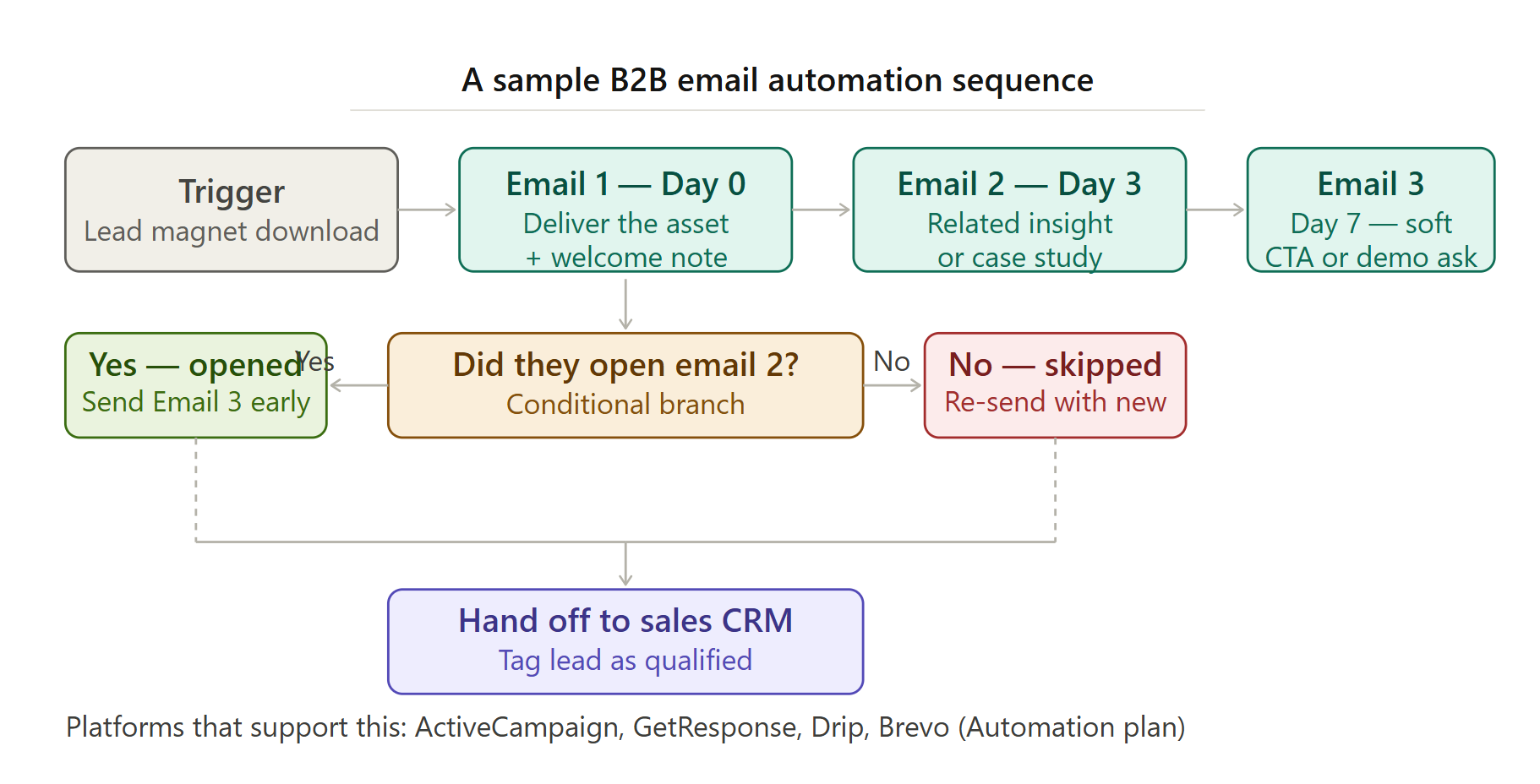
A B2B nurture sequence is not a three-email welcome flow. It branches based on behavior, adjusts timing based on engagement, routes leads to sales at the right moment, and can run different tracks for different personas simultaneously.
The automation engine is where most email platforms separate themselves from their competitors.
3. Deliverability at volume.
In B2B, you are often sending to corporate email addresses with strict spam filters and security gateways. A platform with mediocre deliverability infrastructure can quietly destroy an otherwise solid campaign by landing in spam folders without any visible signal that something is wrong.
4. CRM integration or CRM replacement.
B2B email does not exist in isolation. It needs to connect to your CRM so that sales know when a lead has reached a certain engagement threshold, and so that email sequences can pause automatically when a deal moves to active negotiation. The tightness of this integration varies considerably across platforms.
The best email marketing software for B2B in 2026
1. Brevo (best for high-volume B2B senders who want pricing that scales sanely)
Brevo built its market position on a pricing model that most email platforms refuse to offer: you pay based on the number of emails sent, not the number of contacts stored. For B2B teams with large lists but lower sending frequency, this is a significant structural advantage.
A database of 50,000 contacts that you email twice a month looks very different from a consumer platform perspective than from Brevo’s. On most platforms, 50,000 contacts puts you in a tier designed for frequent senders, and you pay for that capacity whether you use it or not. Brevo charges for what you actually send.
The platform has matured considerably since its earlier years as Sendinblue. The automation builder is capable of handling multi-branch workflows with behavioral triggers. The transactional email capability is built in natively, which matters for B2B teams that also need to send system notifications and receipts. The addition of SMS, WhatsApp, and live chat in the same platform gives teams a single vendor for most of their outbound communication channels.
The AI email generation tools added in 2024 are functional without being exceptional. They produce usable drafts that still need human editing for B2B audiences, which is appropriate.
Where Brevo works well: B2B companies with large contact databases that email at a moderate frequency. Teams that want multi-channel communication (email, SMS, plus WhatsApp) without managing separate vendors. Organizations in Europe that need GDPR-native tooling.
Where it falls short: The CRM built into Brevo is basic. For teams that need a serious CRM alongside marketing automation, Brevo works better as a sending layer that integrates with a dedicated CRM than as an all-in-one solution. The reporting, while adequate, lacks the depth of ActiveCampaign or Drip for revenue attribution.
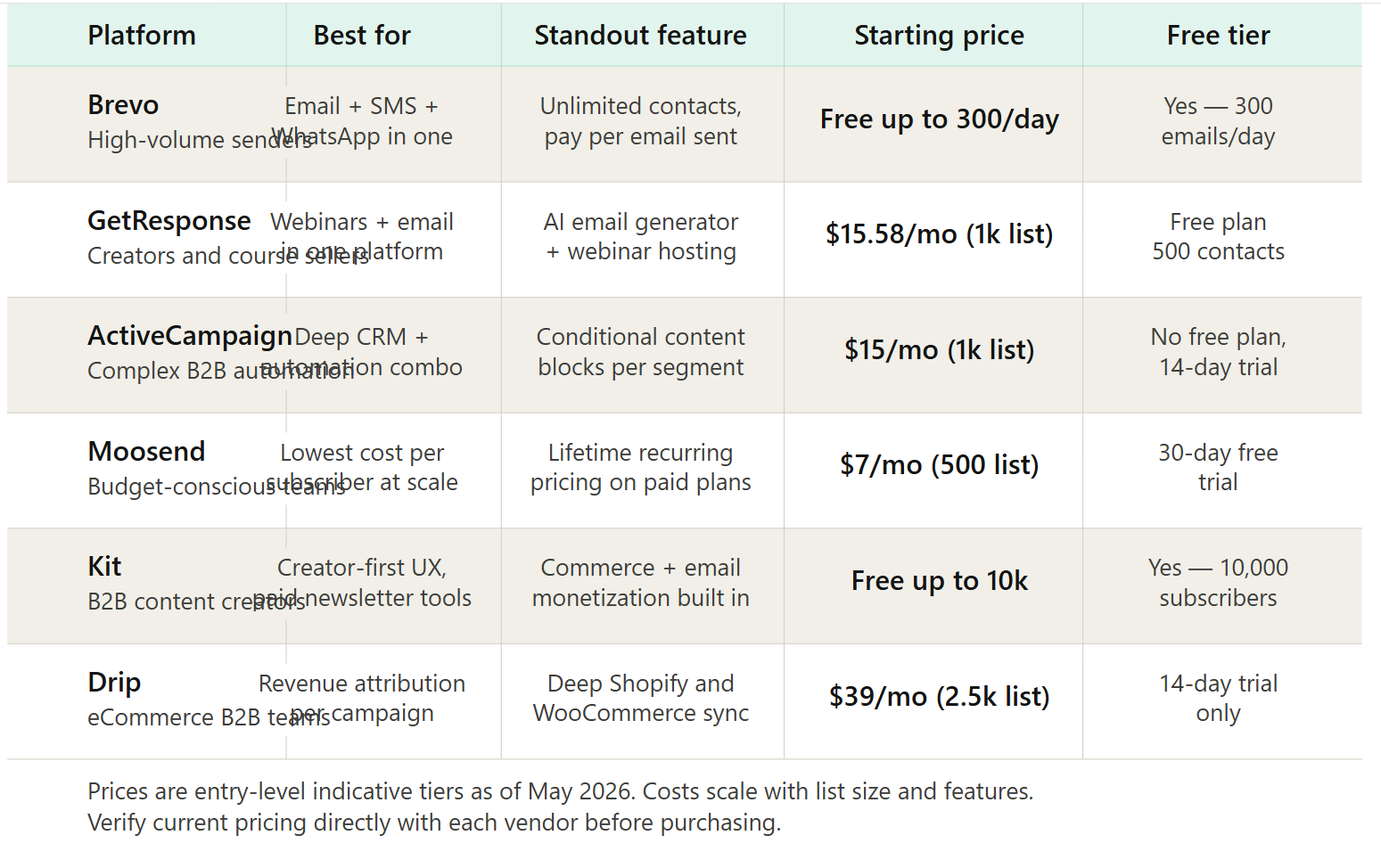
Pricing: A free plan exists for up to 300 emails per day with unlimited contact storage. Paid plans start based on sending volume rather than contacts.
2. GetResponse (best for B2B companies that use webinars as a demand generation channel)
GetResponse occupies an interesting position in the market because it solved a problem that most email platforms ignored: B2B companies that use webinars as a primary lead generation and nurturing channel have historically needed a separate webinar tool alongside their email platform. GetResponse folded webinar hosting into the email marketing platform at a price point that makes the separate tool unnecessary for most teams.
The email automation is solid and handles the branching workflows that B2B nurture sequences require. The AI email generation tools are among the more polished in this category, producing content that requires less editing than comparable tools. The landing page builder is included and functional, reducing the need for yet another separate tool in the stack.
The reporting has improved significantly. You can now track how contacts move through automations and where drop-off occurs, which gives marketing teams the data they need to optimize sequences without relying on third-party analytics.
Where GetResponse works well: B2B marketing teams that run regular webinars, virtual events, or live demos as part of their pipeline generation strategy. Companies that want email, landing pages, and webinar hosting from a single vendor. Teams at the growth stage that want a consolidated tool before they need the more sophisticated (and expensive) tiers of ActiveCampaign.
Where it falls short: The CRM features are limited. GetResponse works best as a marketing tool that hands off to a dedicated sales CRM, not as a replacement for one. The more advanced automation features require higher pricing tiers that can make the cost comparison with ActiveCampaign tighter than the entry-level pricing implies.
Pricing: A free plan supports up to 500 contacts. Paid plans start at around $15.58 per month for a list of 1,000 contacts. Webinar hosting is available from the mid-tier plans.
3. ActiveCampaign (best for B2B teams that need serious marketing automation)
ActiveCampaign is the platform that serious B2B marketing operations teams tend to land on when they outgrow simpler tools. The automation engine is genuinely powerful: it handles complex branching logic, conditional content blocks, lead scoring, and CRM-integrated workflows in a way that few competitors match at a comparable price point.
The combination of email marketing and CRM in one platform is a meaningful differentiator. Rather than maintaining a sync between a marketing platform and a separate CRM, smaller B2B teams can run both from ActiveCampaign. The sales CRM handles deals and pipelines, the marketing automation handles nurture sequences, and the two share contact data natively.
The conditional content feature deserves particular attention. You can build a single email template that shows different content blocks to different audience segments, which means a single campaign can speak to a CMO and a sales operations manager in ways that are genuinely relevant to each, without building two separate campaigns.
Deliverability is a consistent strength. ActiveCampaign’s infrastructure and reputation management is among the best in this market, which matters materially for B2B senders reaching corporate inboxes.
Where ActiveCampaign works well: B2B marketing teams with complex nurture requirements, multiple personas, or long sales cycles that require multi-touch, multi-sequence approaches. Companies that want CRM and marketing automation to share a single data layer without integration overhead.
Where it falls short: The learning curve is real. ActiveCampaign’s power comes with interface complexity that takes time to navigate. Teams without a dedicated marketing operations resource may find themselves underusing the platform. Pricing at higher tiers is not cheap, and the cost scales with contact volume in ways that require careful planning.
Pricing: Plans start at $15 per month for up to 1,000 contacts on the Starter plan. Meaningful automation features require the Plus plan. No free plan is available, but a 14-day trial is.
4. Moosend (best for budget-conscious B2B teams that need more than basic email)
Moosend has built a reputation as the platform that gives you ActiveCampaign-adjacent features at prices closer to simpler tools. The automation builder supports multi-branch workflows, behavioral triggers, and lead scoring. The email editor is modern and produces clean output. The reporting covers the metrics that matter without overwhelming teams with data they will not act on.
For B2B teams that need more than a basic newsletter tool but cannot justify the per-user cost of ActiveCampaign at their current stage, Moosend occupies a useful middle ground. The pricing model is contact-based and remains competitive even as lists grow past 10,000 contacts.
Where Moosend works well: Growing B2B companies that have outgrown entry-level tools but are not yet at the scale where ActiveCampaign’s full power justifies its cost. Marketing teams that need solid automation without a dedicated marketing operations resource to manage platform complexity.
Where it falls short: The CRM integration options, while present, are not as deep as ActiveCampaign’s native CRM capability. The platform also has less brand recognition, which occasionally creates friction when integrating with third-party tools that prioritize major platform connectors.
Pricing: A 30-day free trial is available. Paid plans start at $7 per month for up to 500 contacts, making it one of the most cost-efficient options on this list at early list sizes.
5. Kit (best for B2B teams built around content and thought leadership)
Kit, formerly ConvertKit, was built for creators and has remained deliberately focused on that use case even as the company has grown. For B2B teams whose primary marketing motion is content-led, where a newsletter or thought leadership series is the top of the funnel, Kit’s creator-centric design is a genuine fit rather than a compromise.
The free plan is exceptionally generous: up to 10,000 subscribers with core email functionality included. For a B2B company in the early stages of building a content audience, this removes the cost barrier entirely during the period when list building is the primary goal.
The paid newsletter and monetization tools built into Kit are relevant for B2B companies that use paid newsletters or premium content as a lead generation mechanism. This is a distribution strategy that has grown considerably in B2B circles over the past two years.
The automation is clean and functional, though it lacks the branching complexity of ActiveCampaign for teams that need highly conditional workflows.
Where Kit works well: B2B founders, consultants, and companies whose primary marketing channel is a newsletter or content series. Teams that want a generous free tier during the list-building phase. Organizations running paid content or premium newsletter products as a business development tool.
Where it falls short: Kit is not built for complex B2B marketing automation. If your use case goes beyond nurture sequences and newsletter management into multi-touch, multi-persona campaigns with deep CRM integration, you will outgrow Kit quickly.
Pricing: Free for up to 10,000 subscribers with core features. Paid plans add advanced features and remove sending limits.
6. Drip (best for B2B teams selling to or through eCommerce businesses)
Drip occupies a specific niche that is genuinely underserved by general-purpose email platforms: B2B companies that sell into eCommerce businesses, or that run eCommerce operations themselves as part of a B2B model. Its native integration with Shopify and WooCommerce is deep enough to pull in purchase history, abandoned cart data, and customer lifetime value at the contact level, enabling segmentation and personalization that general platforms cannot match without middleware.
The revenue attribution reporting is Drip’s clearest differentiator. You can see directly which email campaigns contributed to which purchases, at an individual contact level, without custom reporting setup. For B2B eCommerce teams that need to demonstrate email’s contribution to revenue, this is material.
Where Drip works well: B2B companies that sell through or to eCommerce businesses. SaaS companies that have eCommerce transactional components. Teams were proving that email’s revenue contribution is a priority for budget justification.
Where it falls short: If your B2B model has nothing to do with eCommerce, Drip’s advantages disappear, and its higher starting price becomes harder to justify against Brevo or ActiveCampaign.
Pricing: Plans start at $39 per month for up to 2,500 contacts. A 14-day trial is available.
The email marketing features that actually matter for B2B in 2026
The feature lists on email marketing platform websites have grown long enough to be nearly useless as evaluation tools. Here is a shorter, more actionable list of what separates effective from ineffective B2B email tools.
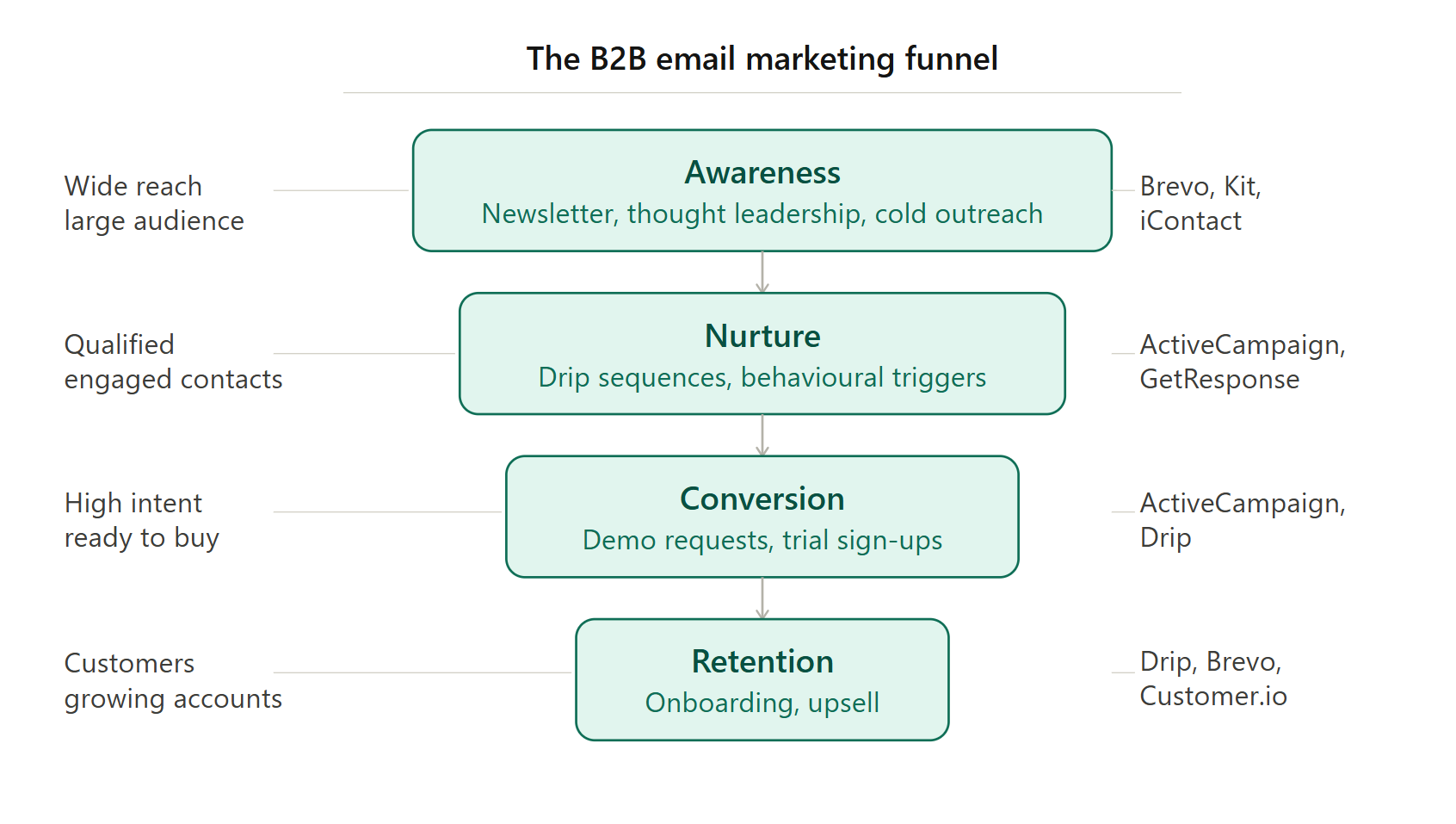
1. Behavioral triggers.
The ability to send an email based on what a contact does, not just based on a time delay, is the foundation of effective B2B nurture.
A contact downloading a specific piece of content, visiting a pricing page, or clicking a particular link in a previous email should be able to trigger a different sequence. Every platform on this list supports this. Many cheaper alternatives do not.
2. Lead scoring.
Assigning point values to contact behaviors and using those scores to route leads to sales or trigger different automation paths is a feature that separates marketing automation from basic email tools.
ActiveCampaign and GetResponse implement this well. Brevo’s implementation is more limited.
3. CRM handoff.
The moment a contact reaches a scoring threshold or completes a conversion action, the email platform needs to alert sales in a way that is actionable.
Whether that is a native CRM feature, a direct integration with Pipedrive or Close, or a webhook that fires into your CRM, the handoff mechanism needs to be reliable and immediate. Missed handoffs are where B2B pipeline leaks happen.
4. List hygiene tools.
Invalid email addresses, contacts who have not opened an email in 18 months, and hard bounce accumulation all damage deliverability over time.
Platforms that make it easy to identify and remove these contacts protect your sender reputation. Brevo and ActiveCampaign handle this well. Some budget platforms require manual management.
5. A/B testing at the automation level.
Testing subject lines on broadcast campaigns is table stakes.
The more useful capability is testing automation branches, such as whether a contact who receives a case study email before a demo request email converts at a higher rate than one who receives them in reverse order. ActiveCampaign and GetResponse support this. Most simpler platforms do not.
Why is Mailchimp not in this list?
Mailchimp is conspicuously absent. That is deliberate.
Mailchimp remains one of the most recognized names in email marketing, and for consumer and general SMB use cases, that recognition is not undeserved. For B2B teams, the picture is different. The automation capabilities are limited compared to ActiveCampaign, GetResponse, and Drip.
The pricing at higher list sizes has increased materially over the past three years. The B2B-specific features, particularly around CRM integration and lead scoring, are underdeveloped relative to competitors that have focused specifically on that use case.
If your team is currently on Mailchimp and finding that it cannot handle the complexity of your B2B nurture sequences, every platform on this list represents a meaningful upgrade. The migration is a one-time cost. The gap in capability is ongoing.
How to choose the best email marketing software for B2B
Choose Brevo if you have a large contact database, send at moderate frequency, want multi-channel communication, or are based in Europe with GDPR as a primary concern.
Choose GetResponse if webinars are a significant part of your demand generation and you want email, landing pages, and webinar hosting in one place without paying for three separate tools.
Choose ActiveCampaign if you need serious marketing automation with complex branching, conditional content, and built-in CRM functionality, and you have someone on the team who will invest the time to configure it properly.
Choose Moosend if you have outgrown basic tools but cannot yet justify the cost or complexity of ActiveCampaign, and want solid automation at a lower price point.
Choose Kit if your primary B2B marketing motion is a newsletter or content series and you want a generous free tier to build an audience before committing to a paid plan.
Choose Drip if your B2B model involves eCommerce, either selling to merchants or operating your own eCommerce component, and revenue attribution at the campaign level matters.
The question of AI-generated email content
Every platform on this list added AI writing tools in 2024, and most have continued improving them into 2026. The honest assessment is that AI-generated email copy has become useful as a first draft for B2B content, but has not replaced the need for human editing before anything goes to a professional audience.
B2B email readers are sophisticated. They recognize generic language and respond to specificity. An AI-drafted email that has been edited by someone who understands the audience and the product performs well. An unedited AI email performs about as well as you would expect: adequately on metrics that measure activity, poorly on metrics that measure genuine engagement and pipeline contribution.
Use the AI tools as a starting point and a speed accelerator. Not as a publishing mechanism.
The bottom line
Email marketing software is one of the few SaaS categories where the right choice genuinely depends on how you market, not just how much you can spend. A content-led B2B company and a high-volume outbound B2B company have entirely different requirements that the same platform will serve well or poorly.
The six platforms covered here represent six distinct approaches to the same fundamental challenge. Match the approach to your actual marketing motion, run a trial with real data from your existing list, and make the decision based on what the platform does with your specific contacts and sequences, not what the demo environment shows with synthetic data.
SaaSXtra covers B2B SaaS tools with the depth that vendor comparison pages and review aggregators do not. If this guide was useful, the comparisons on CRM software and sales engagement platforms cover the adjacent tools that connect to your email marketing stack.

Adeyemi Adetilewa is a digital marketing specialist focused on SaaS, marketing, and online business. He leads the editorial direction at SaaSXtra.com and has driven over 10M+ content views through strategic content marketing. His work has been published and trusted by platforms including HackerNoon, HuffPost, Addicted2Success, and others.