Every week in 2026, another article announces that AI is transforming some industry. Most of these pieces are long on prediction and short on verified evidence. They tell you what AI will do. They rarely tell you what AI companies are actually earning right now.
This report does something different. We analyzed verified Stripe transaction data from more than 30 AI startups whose revenue is publicly available. Every number in this report reflects real transactions processed through real Stripe accounts, not projections, not self-reported claims, not pitch deck estimates.
Here is the state of AI startups in 2026, built on the only foundation that actually matters: verified revenue.
State of AI Startups 2026: The headline numbers
Before diving into the analysis, the top-line figures from the dataset:
- Total verified revenue across analyzed AI startups: Over $35 million in cumulative Stripe transactions
- Highest single-company verified revenue: $9.1 million (Rezi)
- Highest current MRR: $128,000 (PROSP)
- Highest 30-day revenue: $540,000 (Comp AI)
- Number of AI startups with over $1 million in verified revenue: 8
- Number of AI startups with over $500,000 in verified revenue: 14
These are not venture-backed unicorns. These are independent founders who connected their Stripe accounts and published their numbers.
Who is generating the most revenue?
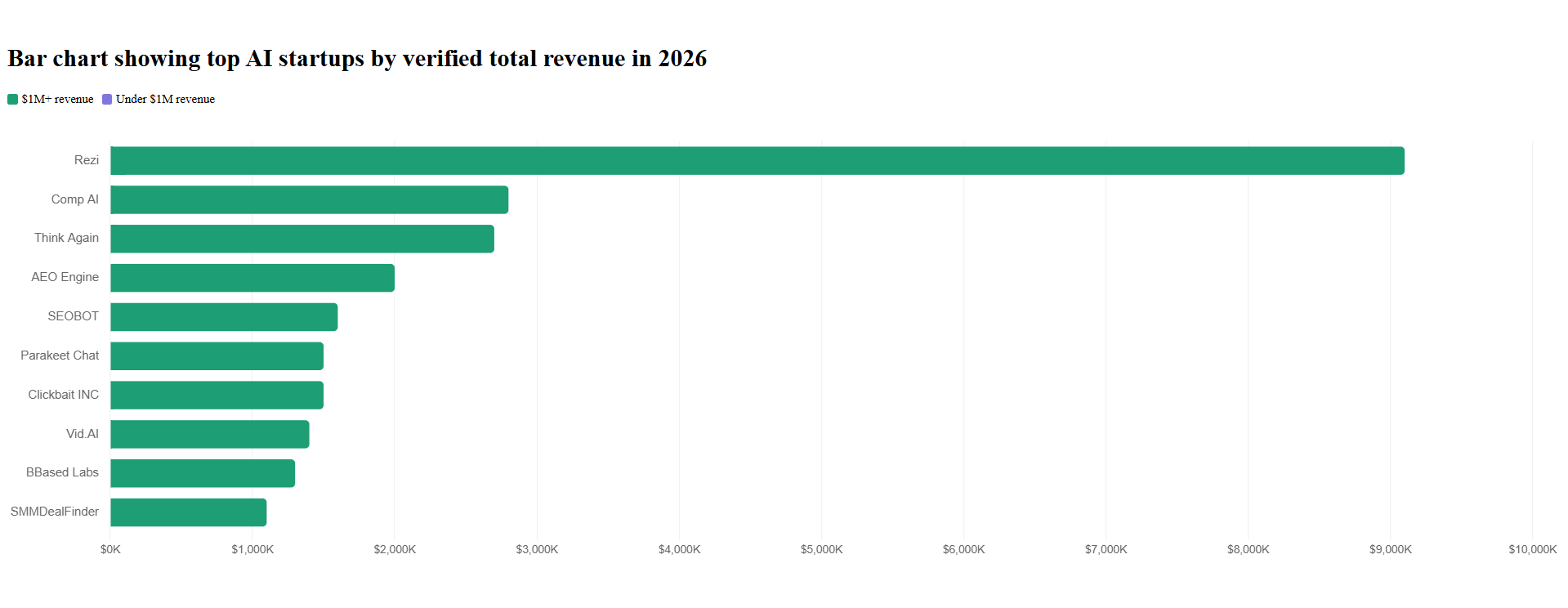
1. Rezi ($9,100,000 in verified revenue)
Rezi is the highest-verified-revenue AI startup in our dataset, and it is not close. With $9.1 million in total Stripe transactions, $293,000 current MRR, and $276,000 in revenue over the last 30 days, Rezi has built a scale that most AI founders only discuss in their pitch decks.
Rezi is an AI-powered resume builder. Not an AI agent framework. Not a foundation model. A resume builder. It has approximately 1 million new users annually, serves over 300 enterprise organizations, including a Fortune 500 company, and is actively building a recruiter-to-job-seeker connection layer on top of the resume product.
The lesson from Rezi is one the AI startup community consistently underweights: the highest-revenue AI products are not the most technically ambitious ones. They are the ones that solve a specific, high-frequency, emotionally important problem for a large, addressable buyer.
Every professional who needs a job needs a resume. Rezi captured that specific moment with an AI product and built $9 million in verified revenue doing it.
2. Comp AI ($2,800,000 in verified revenue, $540,000 in the last 30 days)
Comp AI helps companies achieve compliance with cybersecurity frameworks, including SOC 2 and ISO 27001. It has $2.8 million in total verified revenue and generated $540,000 in the last 30 days alone, the highest single-month figure in the AI category dataset.
The $540,000 30-day figure is worth examining. At that run rate, Comp AI is generating over $6 million annually. The product sits at the intersection of two of the highest-willingness-to-pay categories in B2B software: AI and cybersecurity compliance. Enterprise buyers pay significant sums to achieve SOC 2 certification. Comp AI compresses the timeline and reduces the cost of that process. The ROI is direct and measurable.
Comp AI’s current MRR of $12,000 is low relative to the 30-day revenue, which suggests the $540,000 figure includes a significant volume of one-time or project-based charges rather than pure monthly subscription revenue. This is common in compliance software, where implementation fees and certification-cycle-based billing supplement subscription revenue.
3. AEO Engine ($2,000,000 in verified revenue, $53,000 MRR)
AEO Engine is a content and visibility platform that uses AI agents to expand a company’s presence across Google, ChatGPT, AI Overviews, Perplexity, and other search surfaces. It has $2 million in verified revenue, $77,000 in 30-day revenue, and $53,000 current MRR.
AEO Engine is notable because it is one of the first verified-revenue AI startups built specifically around Answer Engine Optimization, a term that describes the practice of optimizing content for AI search tools rather than traditional Google rankings. As AI search gains market share, AEO is becoming a genuine category, and AEO Engine has positioned itself at the front of it with real revenue to show.
4. SEOBOT ($1,600,000 in verified revenue, $66,000 MRR)
SEOBOT is an AI agent for SEO that handles keywords, research, blog content, mini apps, and programmatic SEO at scale. It has $1.6 million in total verified revenue, $66,000 current MRR, and $71,000 in the last 30 days, suggesting steady growth rather than a spike.
SEOBOT is based in Turkey, which reinforces the consistent finding across our broader dataset: geography is not a constraint for AI startups generating significant recurring revenue. SEOBOT’s buyers are global. Its distribution is through SEO and content marketing, which is the most appropriate channel for an SEO automation tool.
5. PROSP ($507,000 in verified revenue, $128,000 MRR)
PROSP automates LinkedIn outreach with AI and has the highest current MRR of any startup in the AI category dataset at $128,000. With $98,000 in 30-day revenue, it is one of the strongest current performers in the category, even though its total verified revenue ($507,000) is lower than that of many older companies in the dataset.
The high MRR relative to total revenue reflects PROSP’s recency: it is a newer company generating strong recurring revenue quickly. At $128,000 MRR, PROSP’s annualized run rate is over $1.5 million, placing it on a trajectory to join the $1M+ total revenue club within months if growth continues.
The revenue distribution among AI startups
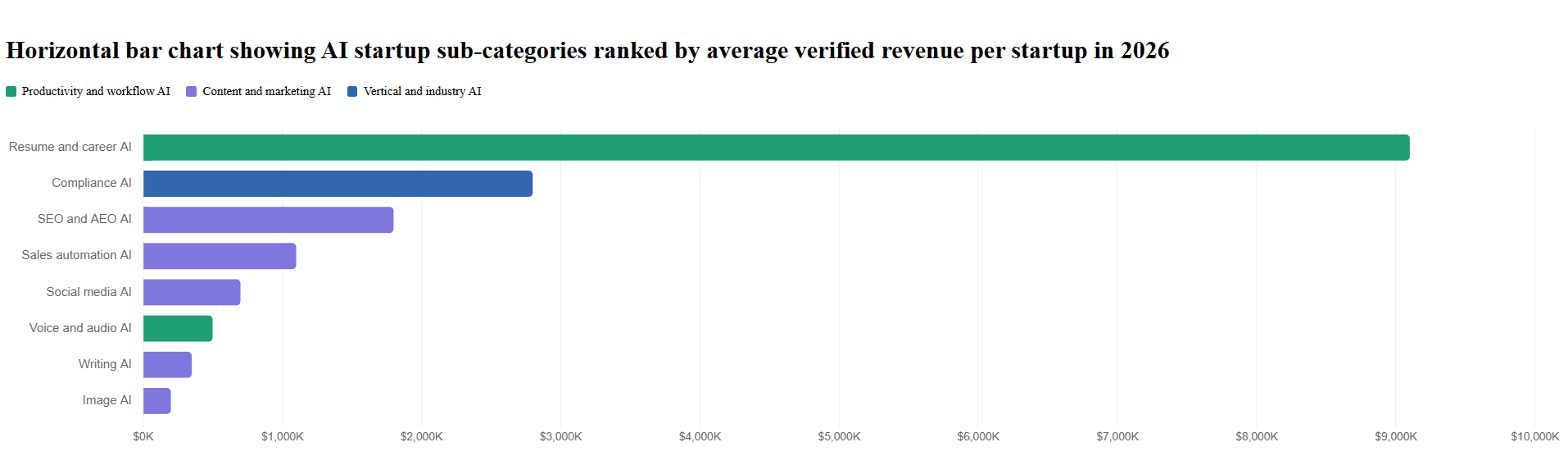
The revenue distribution among AI startups follows the same power-law pattern observed across all software categories.
A small number of companies generate the vast majority of verified revenue. The top three companies (Rezi, Comp AI, Think Again) account for roughly 42% of all verified revenue across the 30 startups analyzed. The bottom 15 companies together account for less than 5% of the total.
This is not a finding unique to AI. It is the fundamental structure of software markets. But it has a specific implication for AI startup founders: the question is not “can I build an AI startup?” but “can I build an AI startup in a specific category with specific buyers who have demonstrated willingness to pay enough to put me in the top 10% of the revenue distribution?”
The top 10% in this dataset start at approximately $550,000 in total verified revenue. The top 5% starts at approximately $1.6 million.
What AI sub-categories are generating the most revenue?
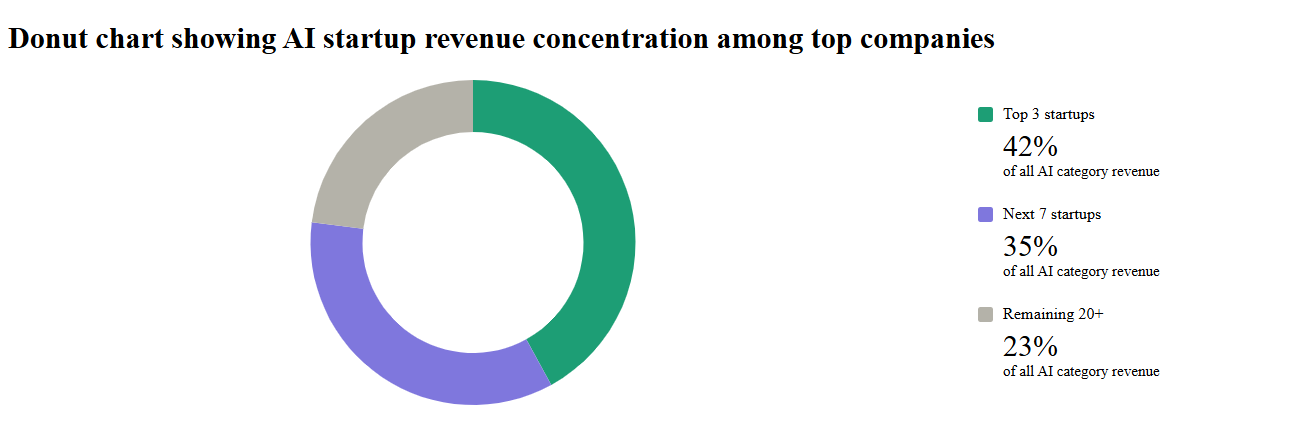
Looking across the 30 AI startups in the dataset, clear sub-category patterns emerge. The highest-revenue AI products are not the most technically sophisticated. They are the most problem-specific.
1. Resume and career AI leads all sub-categories with Rezi at $9.1 million in verified revenue. The problem is universal, the buyer is emotionally motivated, and the AI improvement over a blank document is immediately visible.
2. Compliance and security AI is the second highest, with Comp AI at $2.8 million and $540,000 in the most recent 30 days. Enterprise compliance buyers have the highest willingness-to-pay of any buyer profile in the dataset. Reducing a SOC 2 audit from 12 months to weeks has a clear dollar value that justifies premium pricing.
3. SEO and AEO AI cover both SEOBOT ($1.6 million) and AEO Engine ($2 million), two products that together represent over $3.6 million in verified revenue. AI-assisted SEO content and AI search optimization are converging into a single category as search behavior shifts toward AI-generated answers.
4. Sales automation AI includes PROSP ($507,000, $128,000 MRR) and Setter AI ($157,000). Sales automation has the highest average MRR of any AI sub-category because buyers are paying for direct revenue impact. A tool that books more meetings produces measurable ROI within the first billing cycle.
5. Social media AI includes Followr ($388,000) and several other tools. Social media AI is growing rapidly, but the average revenue per company is lower than B2B-focused AI sub-categories, reflecting the lower willingness-to-pay of individual creator buyers versus business buyers.
The geography of AI startup revenue
The geographic distribution of AI startup revenue in our dataset reveals a story similar to the broader independent startup landscape.
The United States produces the highest absolute verified revenue across all AI startups, anchored by Rezi and several other multi-million dollar products. But the most interesting geographic finding is how many high-revenue AI startups are being built outside the US.
SEOBOT is built in Turkey and has $1.6 million in verified revenue. Verbatik AI is built in Moldova. Followr is built by a team with European roots. Setter AI and Zatten serve the Latin American and WhatsApp-dominant market.
The verified data confirms what geography-first startup thinking misses: AI products do not need to be built in Silicon Valley to find global buyers. The AI capabilities are available via API to any founder with an internet connection. The differentiation comes from problem selection, product design, and distribution channel, none of which require a US address.
What the MRR data tells us about AI business model health
Current MRR is the most forward-looking metric in the dataset. It tells you not where a company has been but where it is heading.
PROSP leads all AI startups by current MRR at $128,000 per month. At this run rate, PROSP is generating over $1.5 million annually from its LinkedIn outreach automation product. Its relatively low total verified revenue ($507,000) compared to its high MRR reflects a newer company that is growing quickly rather than an older company that grew slowly.
Rezi follows at $293,000 MRR, which is consistent with its total revenue position. At $293,000 MRR, Rezi is generating over $3.5 million annually from its current subscriber base.
AEO Engine at $53,000 MRR is notable because it is the newest category in the dataset. AEO as a practice did not meaningfully exist two years ago. A product generating $53,000 MRR in a category that is still being defined is a strong early signal of category leadership.
SEOBOT at $66,000 MRR shows consistent, sustained growth rather than a spike-and-fall pattern. Its $71,000 in 30-day revenue is slightly above its stated MRR, suggesting modest ongoing growth rather than decline.
Think Again at $22,000 MRR with $2.7 million in total verified revenue suggests a product that had a strong historical period and is now in a steadier phase. The ratio of total revenue to current MRR implies several years of strong operation.
The methodology behind this report
Every revenue figure in this report is drawn from verified Stripe transaction data from independent startup founders who have publicly disclosed their revenue by connecting their Stripe accounts to a third-party verification platform. All figures represent actual Stripe transactions, not self-reported estimates, pitch deck projections, or analyst forecasts.
The dataset analyzed for this report covers more than 30 AI startups that have made their verified revenue public as of May 2026.
The sample is not exhaustive of all AI startups globally. It is limited to founders who have chosen to verify and publish their Stripe data publicly, which introduces a self-selection bias toward founders who are comfortable with revenue transparency. The dataset likely underrepresents very early-stage AI startups and overrepresents founders who are confident enough in their numbers to share them.
Revenue figures cited are total all-time verified Stripe transactions unless otherwise noted. MRR figures are estimates derived from recurring Stripe charges and may differ from a company’s internally reported MRR if annual plans, refunds, or prorated charges are not fully reflected in the recurring charge estimate.
Key findings from the 2026 AI startup report
1. The highest-verified-revenue AI startup in our dataset is Rezi, a resume builder, with $9.1 million in total verified Stripe transactions and $293,000 current MRR.
2. Comp AI, a SOC 2 and ISO 27001 compliance tool, generated $540,000 in a single 30-day period, the highest monthly revenue figure of any AI startup in the dataset.
3. PROSP leads all AI startups in current MRR at $128,000 per month from its LinkedIn outreach automation product.
4. Eight AI startups in the dataset have crossed $1 million in total verified revenue. Fourteen have crossed $500,000.
5. The top three AI startups by total revenue account for approximately 42% of all verified revenue across the 30 analyzed companies, confirming the power law distribution that characterizes every software category.
6. Resume and career AI, compliance AI, and SEO and AEO AI are the three highest-revenue sub-categories in the dataset.
7. Sales automation AI has the highest average current MRR relative to total revenue, reflecting newer products growing quickly in a high-willingness-to-pay category.
8. AEO Engine’s $53,000 MRR in the AEO sub-category represents an emerging category that did not meaningfully exist 24 months ago and is already generating significant recurring revenue.
9. AI startups are generating meaningful, verified revenue from Turkey, Moldova, France, and multiple other non-US markets, confirming that geography does not constrain AI startup revenue generation.
10. The highest-revenue AI products in the dataset are not foundation models or AI infrastructure tools. They are application-layer products that solve specific, high-frequency problems for buyers with demonstrated willingness to pay.
11. B2B-focused AI products consistently outperform B2C-focused AI products in both total verified revenue and current MRR, reflecting the higher willingness-to-pay of business buyers versus individual consumers.
12. AI products with direct, measurable ROI for their buyers (compliance certification, sales bookings, SEO traffic) command significantly higher pricing than AI products with diffuse or indirect benefits.
13. Pay-as-you-go pricing appears in several high-revenue AI products, suggesting that usage-based pricing models may generate higher total revenue than flat subscription tiers for AI products with variable usage patterns.
14. The AI category is growing across all sub-types, but the highest current momentum is in AEO tools, sales automation, and compliance automation, three categories where the buyer’s pain is acute, measurable, and expensive to solve without software.
15. Based on the trajectory of the highest-MRR companies in the dataset, the AI startup category is likely to produce several new $10 million verified revenue companies within the next 12 to 18 months if current growth rates continue.
What this means for founders considering AI
The 2026 AI startup revenue data delivers a clear message for founders evaluating whether to build an AI product.
The question is not whether AI startups can generate real revenue. The verified data shows they can and do. Rezi at $9.1 million. Comp AI at $2.8 million. AEO Engine at $2 million. These are not edge cases or venture-inflated outcomes. They are Stripe-verified transactions from real buyers.
The question is which AI products generate real revenue and why. The pattern in the data is consistent. High-revenue AI startups solve specific problems for buyers with high willingness to pay. They deliver measurable, near-term ROI that makes the pricing conversation straightforward. And they distribute through channels that reach their specific buyer without requiring a large marketing budget.
The AI startups generating the least revenue in this dataset are the ones that built horizontally, general-purpose writing tools, generic chatbots, and broad productivity enhancers. The ones generating the most are built vertically, one problem, one buyer, one measurable outcome.
That pattern is not unique to AI. It is the pattern across every software category in the verified revenue data. AI changes the cost of building. It does not change the economics of selling.
Frequently asked questions
How much revenue do AI startups make?
Based on verified Stripe transaction data from more than 30 AI startups that have publicly disclosed their revenue, the range spans from under $10,000 in total revenue for early-stage products to $9.1 million for Rezi, a resume builder. The top AI startup by current MRR is PROSP at $128,000 per month.
What types of AI startups make the most money?
Vertical AI products solving specific, high-value problems for B2B buyers generate the most verified revenue. Resume and career AI, compliance and security AI, and SEO automation AI are the three highest-revenue sub-categories in the 2026 dataset.
How long does it take an AI startup to reach $1 million in revenue?
The verified data does not show founding-to-milestone timelines for all companies, but products like Comp AI, which generated $540,000 in a single month, suggest that AI startups in high-willingness-to-pay categories can reach $1 million in total revenue within 12 to 24 months of achieving product-market fit.
Are AI startups profitable?
The verified Stripe data measures revenue, not profit. However, most AI products in this dataset are built by small teams of one to four founders with low overhead. Products generating $50,000 to $100,000 MRR with lean teams are almost certainly operating profitably, given the low infrastructure cost of API-based AI products.
What is the best AI startup idea in 2026?
The highest-revenue AI startups in the verified dataset are solving problems in compliance, career development, SEO, AEO, and sales automation. The common characteristic is a specific, measurable buyer pain with a high willingness to pay. The best AI startup idea is the intersection of a specific problem, a buyer who will pay significantly to solve it, and a distribution channel that reaches that buyer without a large marketing budget.
Methodology: All revenue figures cited in this report are drawn from verified Stripe transaction data from independent startup founders who have publicly disclosed their revenue. All figures represent actual Stripe transactions, not self-reported estimates. The dataset covers more than 30 AI startups with publicly verified revenue as of May 2026.

Adeyemi Adetilewa is a digital marketing specialist focused on SaaS, marketing, and online business. He leads the editorial direction at SaaSXtra.com and has driven over 10M+ content views through strategic content marketing. His work has been published and trusted by platforms including HackerNoon, HuffPost, Addicted2Success, and others.