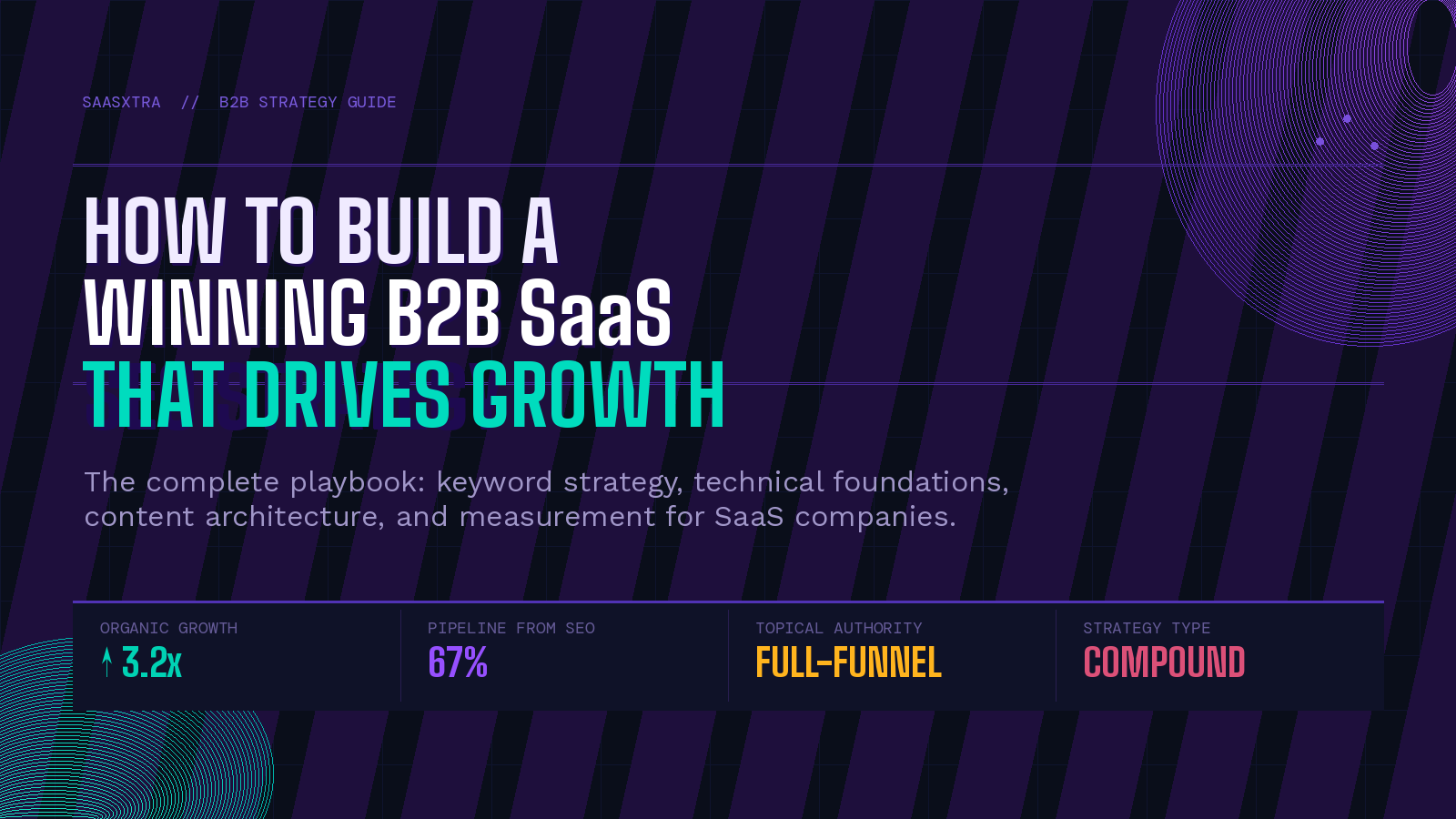
If you are running a B2B SaaS company and your organic pipeline is flat while your paid CAC keeps climbing, this guide exists for you. A B2B SaaS SEO strategy is not a blog calendar or a keyword list. It is a full-funnel growth system that maps your product’s value to the exact searches your buyers run at every stage of a 60 to 180-day decision cycle.
This is the playbook. No vague frameworks, no “publish great content” advice. Concrete execution you can put into motion this week.
Why B2B SaaS SEO Is Its Own Discipline
B2C SEO and even general B2B SEO operate on very different principles from SaaS. Your buyer is rarely the same person as your user. A VP of Revenue Operations who signs the contract never typed a search query. The manager running the evaluation did. Both people need to find you, and they search for completely different things.
B2B SaaS purchases are also committee decisions. Gartner research consistently shows that the average B2B buying group involves 6 to 10 stakeholders. Your SEO strategy has to produce content that satisfies the skeptical IT director, the budget-conscious CFO, and the hands-on end user simultaneously.
The compounding nature of SaaS SEO is what makes it the highest-ROI acquisition channel at scale. Paid search stops the moment you pause spending. A well-constructed organic content engine generates pipeline 24 hours a day, improves with age, and lowers your blended CAC quarter over quarter.
The Foundational Strategy Before You Write a Single Word
Most SaaS companies jump straight to content production. That is the wrong sequence. Strategy comes first.
1. Define Your Ideal Customer Profile Through Search Behavior
Your ICP definition from the sales team is a starting point, not a keyword brief. A “Series B SaaS company with 50-200 employees” tells you nothing about what that company’s operations lead searches for at 9 pm when they are evaluating your category.
Run this exercise before anything else. Take your five best-fit customers and interview them on three questions:
- What were you searching for before you found us?
- What category did you think you were buying when you started the process?
- What alternatives did you consider, and how did you search for them?
Those answers are your seed keyword universe. They reveal the vocabulary your buyers actually use, which is almost never the vocabulary your product team uses internally.
2. Map Your Competitive Search Landscape
Run a gap analysis against your top three organic competitors using tools like Ahrefs or Semrush. Look for three specific signals:
- Keywords your competitors rank for that you do not — this is your fastest opportunity set
- Topics where multiple competitors rank but none dominates — contested ground is winnable
- Questions appearing in People Also Ask boxes that nobody has answered well — these are authority signals LLMs will reward
Do not copy competitor content. Analyze where their content is thin, outdated, or misaligned with actual buyer intent and build something definitively better.
3. Choose Your Topical Authority Pillars
B2B SaaS SEO in 2025 and beyond rewards depth over breadth. Google’s Helpful Content system and LLM-based answer engines like Perplexity and ChatGPT prefer sources that demonstrate genuine expertise across a coherent topic cluster.
Pick three to five topical pillars that map to your product’s core use cases. For a project management SaaS, those pillars might be: team productivity, resource planning, project reporting, remote team collaboration, and professional services delivery. Every piece of content you produce should live within one of these pillars.
Keyword Strategy for the Full Buying Cycle
B2B keyword research is funnel-stage research. The same concept, “project management software,” produces radically different search intent depending on how a buyer phrases it.
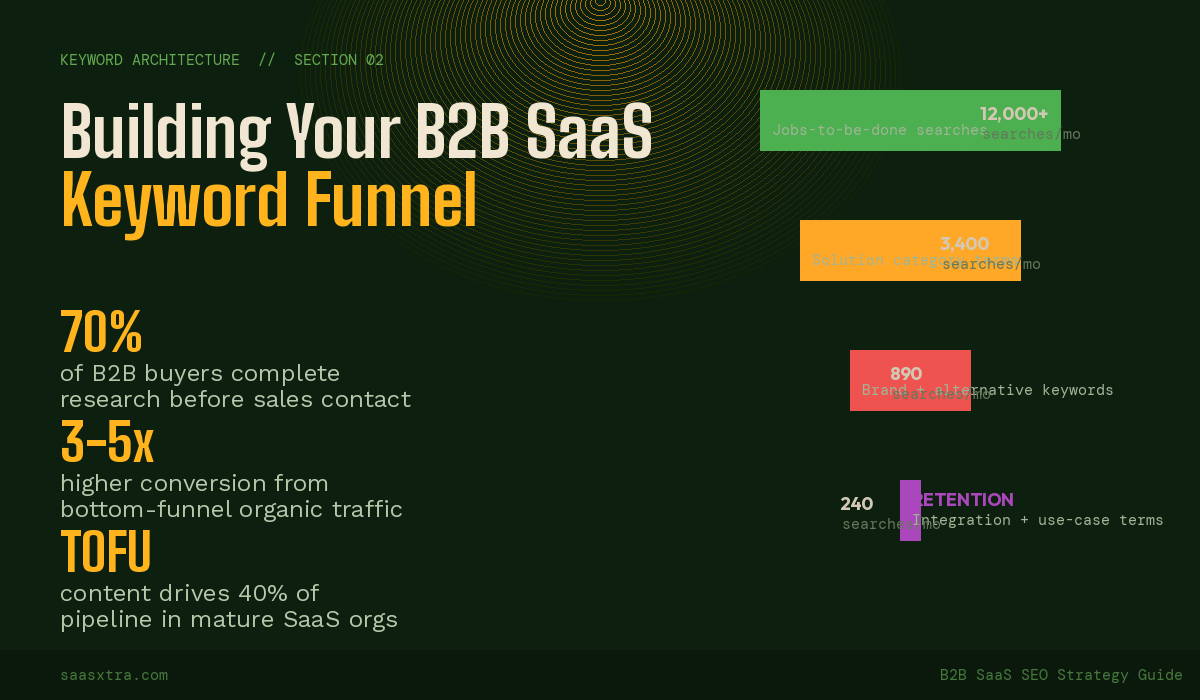
1. Top-of-Funnel: Jobs-to-Be-Done Keywords
TOFU keywords address the problem your product solves, not the product itself. Searches like “how to improve team handoffs,” “cross-departmental project visibility,” or “why projects miss deadlines” come from buyers who do not know your category yet.
These searches have massive volume and low commercial intent. That is a feature, not a bug. Building topical authority on TOFU content is how you become the brand buyers trust before they enter the decision phase. When they are ready to evaluate vendors, you are already familiar.
TOFU content attributes:
- Educational, long-form (2,000 to 4,000 words)
- Minimal product promotion
- Data-driven insights from original research or cited third-party studies
- Strong internal linking toward MOFU assets
2. Middle-of-Funnel: Category and Solution Keywords
MOFU searches signal that the buyer has diagnosed the problem and is now exploring solutions. These are your highest-traffic commercial keywords: “project management software for agencies,” “resource planning tools for consultancies,” “team task management platforms.”
Your MOFU content needs to do two things simultaneously. First, educate buyers on how to evaluate solutions in your category (this positions you as the authority). Second, demonstrate without being obnoxious that your product excels on the evaluation criteria you just defined.
Comparison content sits here: “Asana vs Monday vs ClickUp,” “best project management software for remote teams.” If you are not ranking on competitor alternatives searches, you are losing to comparison sites that are capturing your buyers mid-evaluation.
3. Bottom-of-Funnel: High-Intent Decision Keywords
BOFU keywords indicate a buyer is close to a purchase decision. These searches include:
- “[Your brand] pricing”
- “[Your brand] vs [Competitor]”
- “[Competitor] alternative”
- “[Your brand] reviews”
- “[Category] software for [specific industry].”
BOFU content converts at 3 to 5 times the rate of TOFU content. Volume is low, but these visitors are worth pursuing aggressively. Own every BOFU search about your brand and your closest competitors.
4. Long-Tail Keyword Strategy for SaaS
Long-tail keywords in SaaS are underutilized at most companies. “Project management software” is contested by Asana, Monday, ClickUp, Notion, and a dozen funded competitors. “Project management software for architecture firms with Procore integration” has minimal competition and extremely high purchase intent.
Build programmatic SEO pages for high-value long-tail combinations: your product category + industry vertical, your product category + use case, your product category + company size, your product category + integration ecosystem. Even at 50 searches per month, a page ranking first for that term is likely capturing buyers with a specific, unmet need your product solves.
Content Architecture That Google and LLMs Both Reward
Content architecture is the structural logic that connects your topical pillars, keyword clusters, and individual pages into a coherent knowledge system. This is what separates a blog from a content engine.
1. The Pillar-Cluster Model for SaaS
For each topical pillar, build one cornerstone pillar page (3,000 to 5,000 words, comprehensive, updated quarterly) and 8 to 15 cluster pages that address specific subtopics within that pillar. Every cluster page links back to the pillar. The pillar links out to each cluster.
This architecture signals topical depth to Google’s crawlers and provides LLMs with a coherent, interlinked knowledge base to draw from when generating answers.
2. Content Formats That Win in B2B SaaS
Not all content formats perform equally across the buying cycle. Match format to stage:
| Content Format | Best Stage | Primary Goal |
|---|---|---|
| Ultimate guides/how-to posts | TOFU | Topical authority, brand awareness |
| Comparison pages | MOFU | Capture evaluating buyers |
| Case studies | MOFU / BOFU | Proof of ROI for specific ICPs |
| Pricing pages (optimized) | BOFU | Direct conversion |
| Integration pages | BOFU | Ecosystem discovery |
| Glossary/definition posts | TOFU | Featured snippets, LLM citation |
| Original research/reports | TOFU | Backlink acquisition, brand authority |
3. Writing for LLM Visibility (GEO)
Generative Engine Optimization is no longer optional. When buyers ask ChatGPT, Perplexity, or Google’s AI Overviews “what is the best [your category] software,” your content needs to be in the training or retrieval set those systems draw from.
LLMs favor content that is:
- Factual and citable — include specific statistics with sources linked
- Structured with clear headings — H2 and H3 hierarchy aids extraction
- Direct in its answers — lead every section with the answer, follow with explanation
- Entity-rich — name-specific tools, methodologies, companies, and frameworks
- Authoritative in tone — written by (or clearly attributed to) practitioners with demonstrated expertise
Add an author bio to every article. Include schema markup for author entities. These signals matter for AI-assisted search retrieval.
Technical SEO Foundations for SaaS Platforms
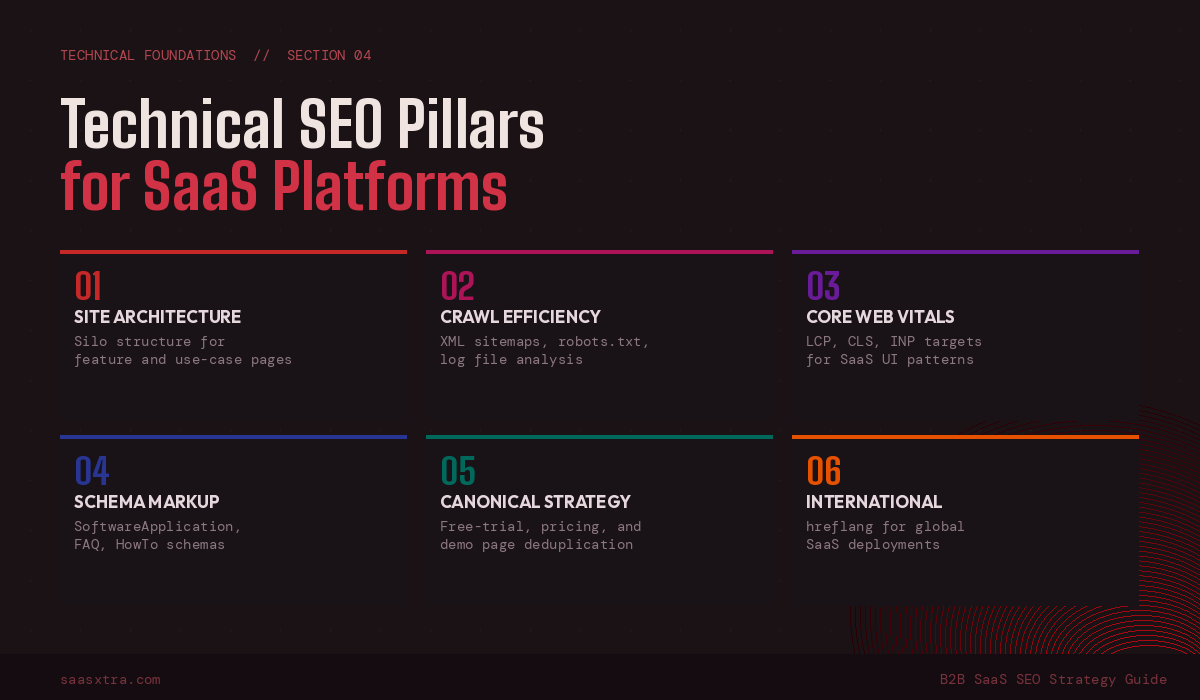
Technical SEO in SaaS platforms carries unique challenges that pure-content publishers never face. Your application generates dynamic URLs, gated content, near-duplicate feature pages, and complex JavaScript rendering requirements.
1. Site Architecture for SaaS Products
Your site architecture should separate four distinct content areas with clear URL hierarchies:
/blog/— editorial content, news, thought leadership/solutions/— use-case and industry-specific landing pages/integrations/— one page per major integration partner/compare/— competitor comparison pages/resources/— templates, calculators, research reports
Avoid putting SEO-critical content inside your application’s authenticated paths. Pages behind login are invisible to crawlers. If your pricing page, feature documentation, or customer case studies require login to view, you are surrendering organic traffic.
2. Core Web Vitals for SaaS UI Patterns
SaaS platforms routinely underperform on Core Web Vitals because product teams optimize for logged-in experience, not first-page load for marketing visitors. Your marketing site is not your product — treat them as separate optimization challenges.
Target metrics for your marketing site:
- LCP (Largest Contentful Paint): under 2.5 seconds
- CLS (Cumulative Layout Shift): under 0.1
- INP (Interaction to Next Paint): under 200ms
Test specifically on mobile and low-bandwidth connections. Many B2B buyers conduct initial research on mobile, even for enterprise software. A 6-second load time on a 4G connection is losing you evaluations before you knew you were being evaluated.
3. Schema Markup Implementation
SaaS companies are among the most underserved segments for schema markup. Implement at minimum:
- SoftwareApplication schema on your product pages with pricing, operating system, and application category properties
- Organization schema on your homepage with your brand’s social profiles, founding date, and contact information
- FAQPage schema on every piece of content that includes a Q&A section
- HowTo schema for tutorial and setup content
- Review/AggregateRating schema for your product once you have review data from G2 or Capterra
These schema types directly influence featured snippet eligibility and AI Overview inclusion.
4. Handling Duplicate Content in SaaS
SaaS platforms generate duplicate content in ways that trip up even experienced marketers. Common sources:
- Pricing pages with multiple billing cycle tabs creating URL parameters
- Trial signup flows are creating near-duplicate landing pages per campaign
- Feature documentation that mirrors blog content
- Faceted search or filter interfaces create hundreds of thin pages
Audit your crawl data quarterly using Screaming Frog or Sitebulb. Every page Google crawls that provides no unique value dilutes your crawl budget and can suppress your stronger pages.
Link Building Strategy for B2B SaaS
Backlinks remain the most durable ranking signal in B2B SaaS SEO. The challenge is that B2B link building is slower and more relationship-dependent than B2C.
1. Original Research as a Link Acquisition System
The single highest-ROI link-building activity for a SaaS company is publishing original research that your industry does not have access to elsewhere. Survey your customer base, analyze anonymized product usage data, or commission a third-party study.
A B2B SaaS research report that receives 200 backlinks from industry publications is worth more in sustained organic traffic than 200 individual guest posts. The links arrive naturally over 12 to 24 months as journalists and analysts cite your data.
The benchmark: A well-executed original research report in a B2B niche can generate 50 to 300 referring domains within 18 months of publication, many from domain-authority-70-plus sources that would never accept a guest post pitch.
2. Digital PR for SaaS
Position your founder or senior leaders as expert sources for journalists covering your category. Register on HARO / Connectively and respond to queries in your space. A single placement in TechCrunch, Forbes, or a major trade publication delivers referral traffic, brand awareness, and a high-DA backlink simultaneously.
Do not pitch your product. Pitch your expertise and your data. Journalists want insights and statistics, not vendor promotion.
3. Partner and Integration Link Building
Your integration ecosystem is an underutilized link source. Every company whose product you integrate with is a potential partner link. Reach out to your integration partners and propose mutual resource pages: “Partner Directory,” “Recommended Tools,” or “Technology Ecosystem” pages.
These links are highly relevant (same industry, same buyer), typically follow (not nofollow), and require zero content creation on your part. If you have 40 integrations and convert half of them to partner links, that is 20 domain-diverse, contextually relevant backlinks from established SaaS companies.
SaaS Content Specific Strategies
1. Build Comparison Pages You Can Control
Buyers search “[Your Brand] vs [Competitor]” whether you have a page for it or not. If you do not create that comparison page, a review aggregator or an affiliate site will rank for it and frame the comparison on their terms, not yours.
Create comparison pages that are:
- Honest about where competitors excel (this builds trust and reduces bounce rate)
- Specific about your product’s differentiated advantages with evidence
- Structured with a clear recommendation for the right buyer profile
- Regularly updated to reflect current feature sets
A comparison page that acknowledges a competitor’s strength while clearly explaining which use cases favor your product will outperform a one-sided hit piece every time. Buyers can detect bias, and biased comparisons damage the credibility of the page that hosts them.
2. Free Tools as SEO Assets
Free tools drive some of the most valuable organic traffic in B2B SaaS. An ROI calculator, a grader tool, a template library, or a benchmarking assessment created by your team can rank for high-intent keywords and capture email addresses from buyers who are actively evaluating whether your category of solution is worth buying.
Examples from the SaaS ecosystem that demonstrate this:
- HubSpot’s Website Grader has driven millions of signups over a decade
- Moz’s Link Explorer is the product that built Moz’s domain authority
- Clearbit’s Logo API became a backlink acquisition machine
Build one free tool per year that directly relates to the problem your product solves. Make it genuinely useful. Promote it. Let it compound.
3. Customer Success Content as SEO
Churn prediction, onboarding optimization, and product adoption content are untapped keyword clusters for most SaaS companies. These searches come from existing customers but also from buyers evaluating whether your product category is adoptable by their team.
“How to onboard a remote team on [category] software,” “best practices for [category] adoption,” and “[category] implementation guide” are high-intent keywords with lower competition than acquisition-stage terms. Ranking here signals to buyers that you invest in customer success, not just customer acquisition.
Measuring Your B2B SaaS SEO Strategy
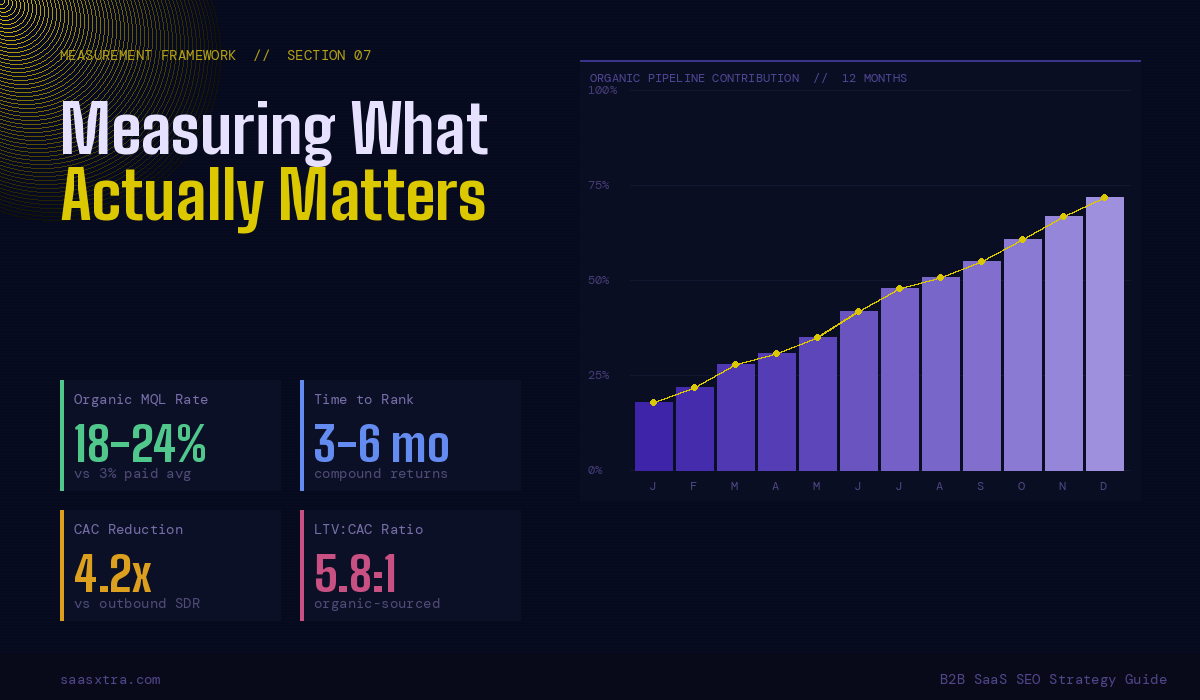
Measuring SEO in B2B SaaS requires going beyond traffic and rankings. Traffic is a leading indicator. Pipeline contribution is the metric that earns budget.
1. The Metrics That Actually Matter
Tier 1: Business Impact
- Organic-sourced pipeline (opportunities with first-touch or multi-touch attribution to organic)
- Organic-sourced MQLs and their conversion rate to opportunity
- Organic CAC compared to paid and outbound CAC
- Organic revenue attribution via your CRM
Tier 2: Performance Indicators
- Keyword rankings for target clusters (tracked weekly, not daily)
- Organic click-through rate by page type
- Organic conversion rate to trial/demo by landing page
- Crawl health score (indexed pages, crawl errors, Core Web Vitals pass rate)
Tier 3: Operational Metrics
- Content production velocity (pieces published per month)
- Link acquisition rate (new referring domains per month)
- Topical coverage score (keywords ranked vs total target keyword universe)
2. Attribution Models for Long Sales Cycles
B2B SaaS sales cycles of 60 to 180 days break last-touch attribution models. A buyer who reads your TOFU blog post in January, downloads a comparison guide in March, and books a demo in May will show up in your CRM as a “direct” or “email” conversion if you use last-touch.
Implement multi-touch attribution. At minimum, capture first-touch source and the full session path before trial/demo request. Tools like Dreamdata and Triple Whale can map multi-session organic journeys for B2B specifically.
Track the time-to-rank for new content as an operational benchmark. Most well-executed SaaS content takes 3 to 6 months to reach its peak ranking position. If your content is not moving within 90 days of publication, it signals one of three issues: insufficient backlink support, thin content that needs expansion, or a technical crawling problem.
3. Reporting SEO to SaaS Leadership
Most SaaS leadership teams do not care about keyword rankings. They care about CAC, pipeline, and payback period. Frame your SEO reporting in the language of revenue operations:
- “Our organic channel delivered 34 MQLs this quarter at a CAC of $280, compared to $1,400 for paid search.”
- “The competitor comparison pages we published in Q1 are driving 18% of our organic demo requests.”
- “At our current content production rate, we project organic to contribute 40% of the total pipeline by the end of the next fiscal year.”
This framing is what earns SEO investment rather than constant budget justification.
Building Your SEO Technology Stack
You do not need expensive tools to execute B2B SaaS SEO. You need the right tools for each function.
Core Tool Categories
1. Keyword Research and Competitive Intelligence
Ahrefs or Semrush for keyword discovery, gap analysis, and SERP tracking. Both are mature platforms. Ahrefs has a stronger backlink database. Semrush has better on-page audit tools. Either works. Pick one and commit. Switching platforms mid-strategy loses your historical trend data.
2. Technical Auditing
Screaming Frog (one-time annual license, not subscription) for crawl analysis. Google Search Console for index coverage, Core Web Vitals, and query performance. Both are non-negotiable at zero or near-zero cost.
3. Content Optimization
Tools like Clearscope, Surfer SEO, or MarketMuse can help optimize content for topical completeness and semantic coverage. These are useful but not essential. A skilled writer with a solid keyword brief can produce equally strong content without them. Start here only after your foundational strategy is in place.
4. Link Building and Outreach
Hunter.io for email discovery. BuzzStream or Pitchbox for outreach management at scale. A simple Airtable database works for most SaaS companies at early stages.
5. Analytics and Attribution
Google Analytics 4 is free and sufficient for traffic analysis. Your CRM (HubSpot, Salesforce) with a first-touch UTM capture setup handles pipeline attribution. Add a multi-touch attribution tool once you are closing more than 20 organic-attributed deals per quarter.
Execution Roadmap (Months 1 to 12)
Months 1 to 3: Foundation
- Complete ICP search behavior research
- Finalize 3 to 5 topical pillars and a 300+ target keyword list
- Fix critical technical issues: crawl errors, duplicate content, missing schema
- Publish 4 cornerstone pillar pages (one per core pillar)
- Launch competitor comparison pages for your top 3 competitors
- Establish baseline metrics in Google Search Console and your CRM
Months 4 to 6: Acceleration
- Publish 6 to 8 cluster content pieces per month
- Begin digital PR and link acquisition outreach
- Launch one free tool or resource asset
- Optimize existing pages based on early ranking data
- Build out your integration partner pages
Months 7 to 12: Compounding
- Scale to 10+ pieces per month if resources allow
- Launch your first original research report with PR amplification
- Expand into programmatic SEO for long-tail industry/use-case combinations
- Conduct quarterly content audits and update underperforming posts
- Present organic pipeline contribution to leadership with full attribution data
The Honest Reality of B2B SaaS SEO
SEO does not produce leads in week three. Any agency or consultant who promises fast rankings for competitive B2B SaaS keywords is either targeting keywords nobody searches for or lying about the timeline.
The compound growth curve is real, but it requires patience. Most SaaS companies that commit to a well-executed SEO strategy see meaningful organic pipeline contribution at months 8 to 12. At months 18 to 24, organic becomes their most efficient acquisition channel. At year three, it is often their largest.
The companies that win in organic search are the ones that start, stay consistent, and treat SEO as a core business function rather than a marketing experiment. If your competitor is investing in SEO and you are not, they are building an asset that will compound in their favor for years.
Start the strategy today. Build it methodically. Measure it honestly. The growth follows.
This guide is part of the SaaSXtra content library for B2B SaaS founders and growth teams. Explore related resources on saasxtra.com.

Adeyemi Adetilewa is a digital marketing specialist focused on SaaS, marketing, and online business. He leads the editorial direction at SaaSXtra.com and has driven over 10M+ content views through strategic content marketing. His work has been published and trusted by platforms including HackerNoon, HuffPost, Addicted2Success, and others.