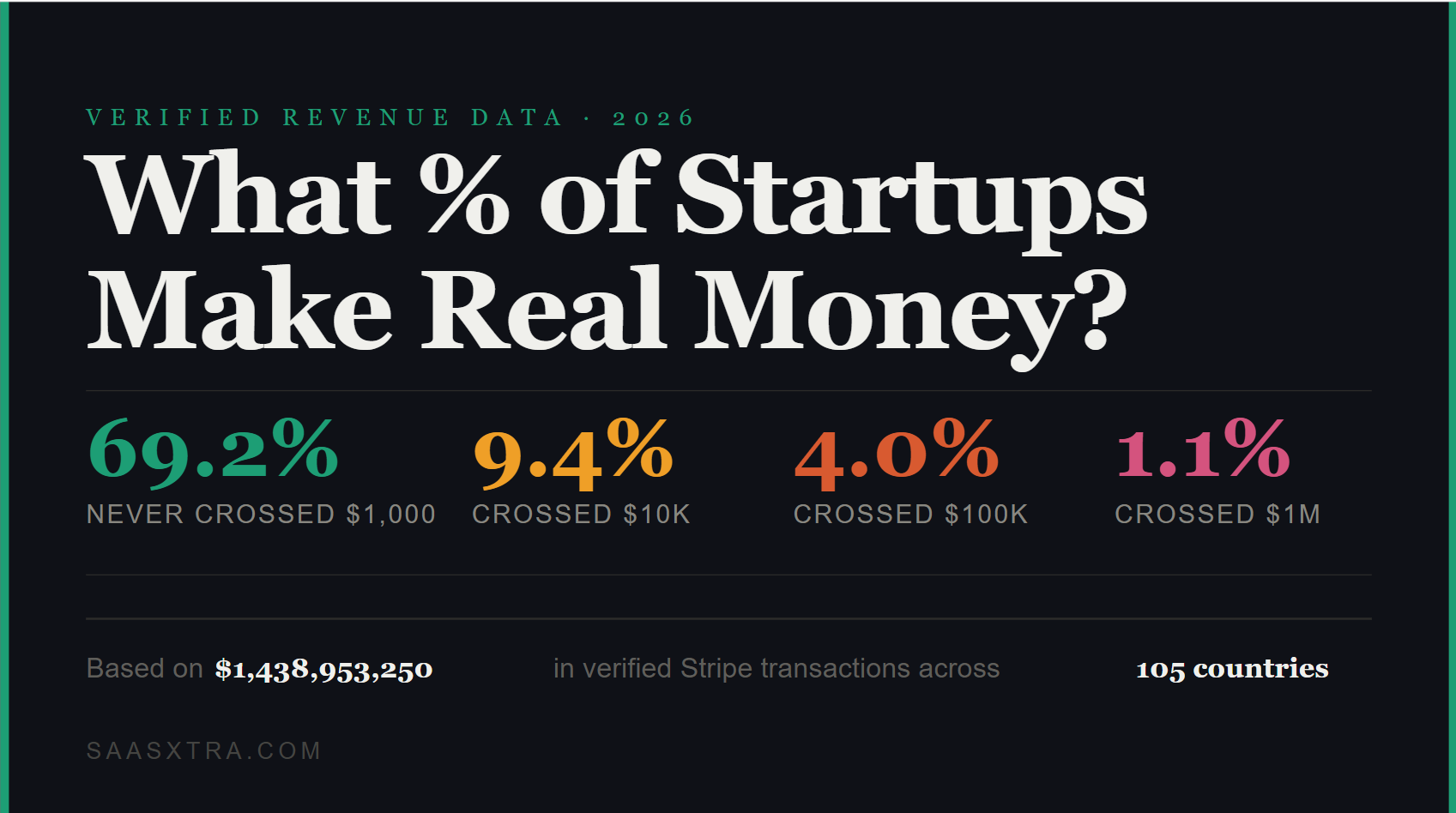
“Most startups fail.” You have read this sentence a thousand times. But what does it actually mean in terms of verified revenue?
The problem with most startup failure rate statistics is that they measure survival, not money made. A startup that exists for five years without generating meaningful revenue is technically “surviving” but producing no value for its founders. A startup that generated $50,000 in transactions before shutting down technically “failed” but produced real results.
What matters is a more precise question: what percentage of startups have actually crossed each revenue milestone, based on verified payment data? The dataset analyzed here covers $1,438,953,250 in total verified Stripe transactions from startups whose revenue is publicly available. Here is what it shows.
The Revenue Distribution of Real Startups
1. 69.2% of startups have never crossed $1,000 in total revenue.
This is the foundational number. More than two-thirds of all startups in the verified database have never reached $1,000 in cumulative Stripe transactions.
This is not a sample of failed startups or abandoned projects. These are startups whose founders valued transparency enough to connect their Stripe account and make their revenue public. The 69.2% who have not crossed $1,000 are not inactive. They are simply at the earliest stage of monetization.
2. 16.3% of startups are in the $1,000 to $10,000 range.
Roughly 1 in 6 startups has generated between $1,000 and $10,000 in total verified revenue. This band represents initial proof that buyers exist, but not yet proof that a scalable distribution channel exists.
Most startups that reach this band found their first customers through launch events, personal networks, or a single specific channel and have not yet solved the repeatability problem.
3. 9.4% of startups have crossed $10,000 in total revenue.
Fewer than 1 in 10 startups have crossed five figures. This is the threshold at which product-market fit is genuinely evidenced.
Getting to $10,000 in total revenue typically requires more than a single lucky launch. It requires a repeatable path to paying customers.
4. 4.0% of startups have crossed $100,000 in total revenue.
4 in 100 startups have crossed $100,000 in total verified revenue. This milestone represents a business rather than a project.
Companies at $100K or more in total revenue have typically found both a working product and a working distribution channel. They are generating enough revenue to sustain operations and, in many cases, the founder’s livelihood.
5. 1.1% of startups have crossed $1,000,000 in total revenue.
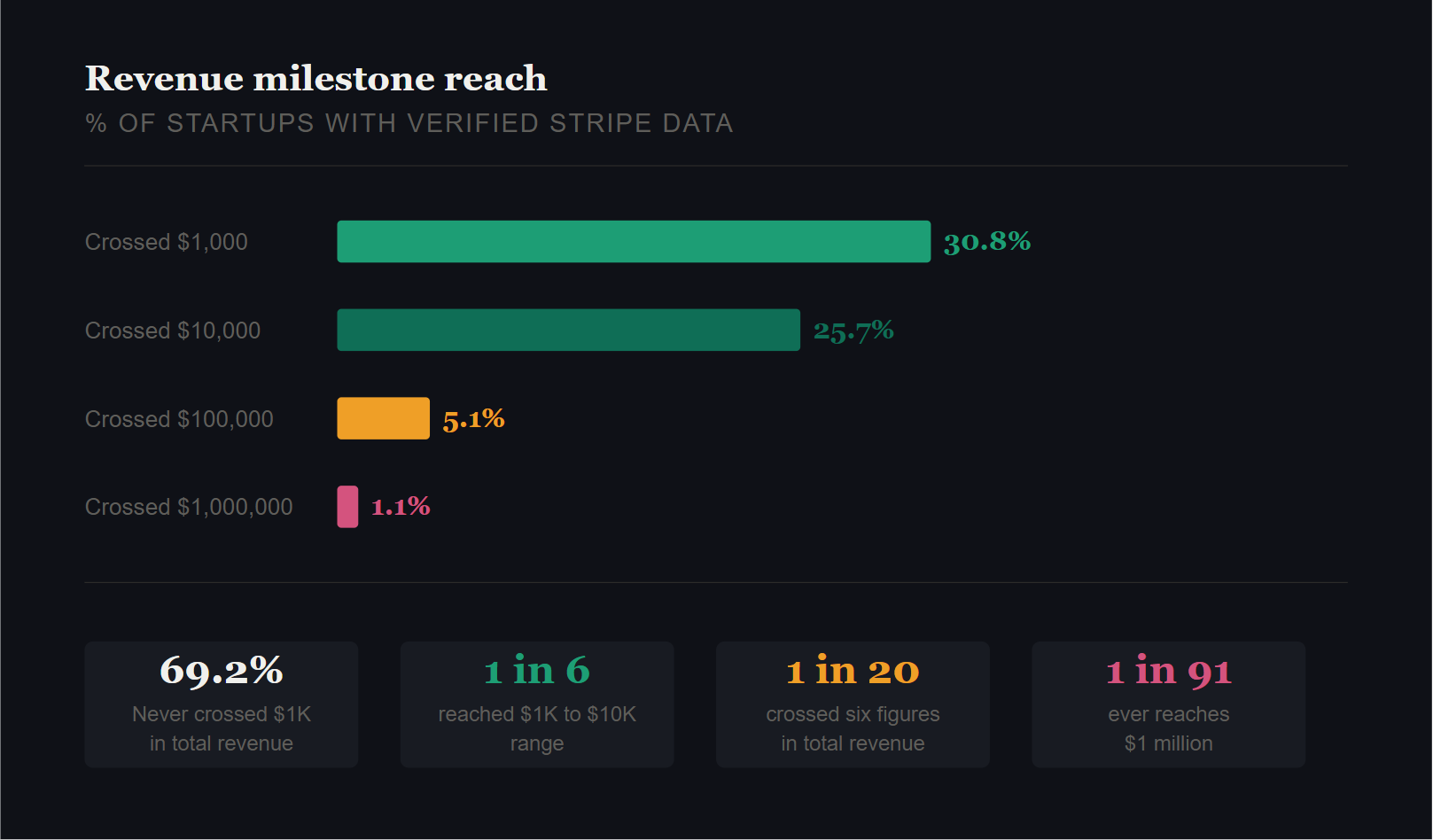
Just over 1 in 100 startups has crossed the million-dollar milestone. The $1M total revenue threshold is the benchmark that most founders target and that fewer than 1 in 91 ever reach.
What “Making Real Money” Actually Means in Startup Terms
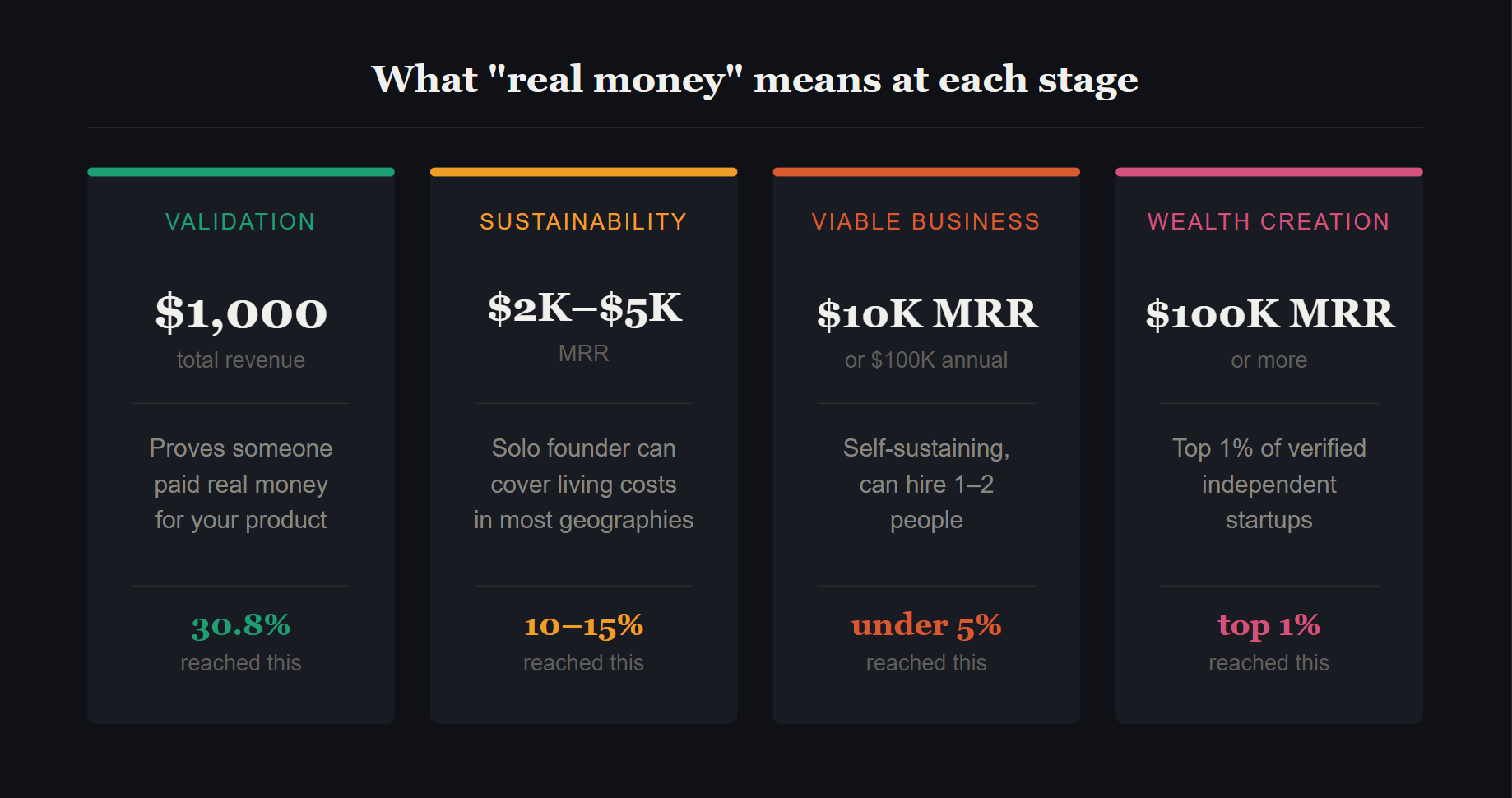
The revenue distribution raises the question of what constitutes “real money” for a startup. The answer depends on the founder’s goal.
For validation
Any paying customer is evidence that your product has value. Getting to $1,000 in total revenue proves someone chose to pay real money for your product. Only 30.8% of Stripe-connected startups have done this.
For sustainability
Getting to $2,000 to $5,000 in monthly recurring revenue is typically the threshold at which a solo founder in a low-cost geography can cover their basic living expenses from their startup. Approximately 10% to 15% of startups in the database are at this level or above.
For a viable business
Getting to $10,000 MRR or $100,000 in annual revenue represents a business that can sustain itself, invest in growth, and employ one or two people. Fewer than 5% of Stripe-connected startups have reached this level.
For wealth creation
Getting to $100,000 MRR or more puts a startup in the top 1% of verified-revenue independent startups. This is the level at which a startup has significant enterprise value and potential for acquisition or long-term compounding.
Verified Data Points on What Percentage of Startups Make Money
1. 30.8% of startups in the verified database have crossed $1,000 in total revenue. The other 69.2% have not.
2. 25.7% of startups have reached $10,000 or more in total revenue.
3. 5.1% of startups have crossed $100,000 in total revenue.
4. 1.1% of startups have crossed $1 million in total revenue.
5. Revenue outpaced follower growth in 78% of analyzed startups, meaning most startups that make money do so without first building a large social audience.
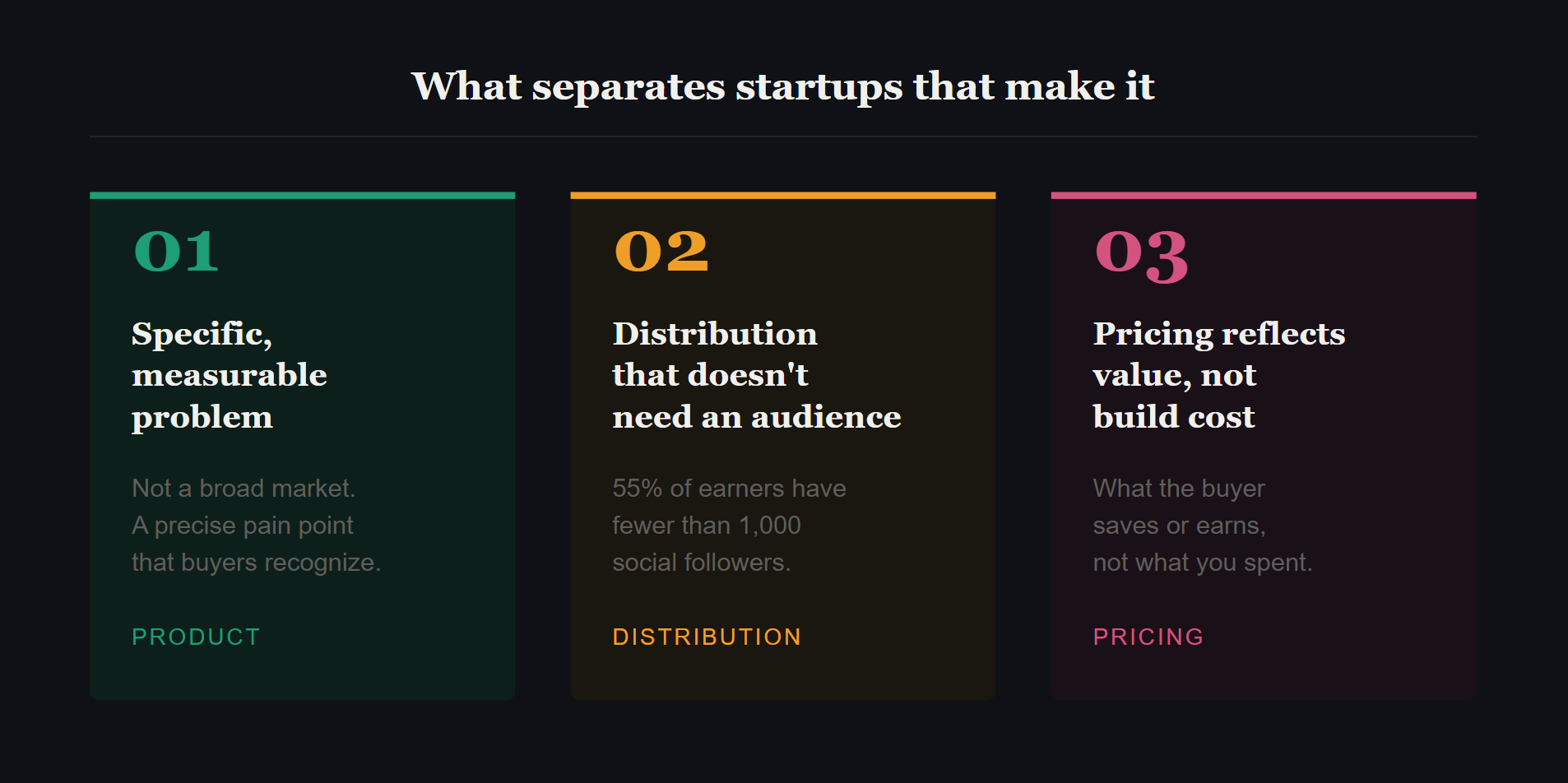
6. 55.1% of founders with verified revenue have fewer than 1,000 followers on X, confirming that social presence and revenue generation are largely independent.
7. The Social Media tools category is growing at 167% in 30-day MRR, the highest current growth rate in the dataset, suggesting a strong current window for reaching early revenue milestones in a new product.
8. The Content Creation category has the highest average MRR at $16,475, meaning startups in this category find traction and cross the real money threshold faster than in any other tracked category.
9. The E-commerce category has the highest total revenue average at $665,500, though the median E-commerce startup has not crossed $100K, given the power law distribution of revenue across the category.
10. Only 4.0% of startups cross $100,000 in total revenue, making this milestone genuinely rare and meaningful regardless of how often it is discussed in startup communities.
11. Five independent founders collectively verified over $7 million in revenue with a combined following of fewer than 150 accounts, demonstrating that making real money does not require a public profile or audience.
12. The average total revenue for the top category is $665,500, but the median startup in that category has not crossed $100K, given how skewed the distribution is.
13. 105 countries have at least one startup with verified Stripe revenue, demonstrating that making real money from an independent startup is achievable from virtually any location with internet access.
14. Revenue generation is dominated by a small number of large players in most categories. Power law distributions mean the average significantly overstates what most founders in any given category actually earn.
15. The $1,438,953,250 in total verified revenue across the dataset represents real money earned by independent founders. Not venture-backed companies, not unicorns, not funded startups. This is the verified baseline of what independent founders can and do earn.
The Honest Assessment
The data on startup revenue is both sobering and motivating.
Sobering because 69.2% of founders who have built something and connected their Stripe account have not generated $1,000 in total revenue. Most startups, even ones built by committed founders who care enough to track and share their revenue publicly, do not reach meaningful commercial traction.
Motivating because 30.8% have crossed $1,000, 14.5% have crossed $10,000, and 5.1% have crossed $100,000. These are not vanishingly small numbers. One in twenty Stripe-connected startups has generated six figures in verified revenue. The path exists. It is narrow, but it is real.
The common thread among the startups that make it to each successive milestone is not luck, location, or funding. It is the combination of a product that solves a specific, measurable problem, a distribution channel that reaches the buyer without requiring the founder to become an influencer, and pricing that reflects the value delivered to the buyer rather than the cost of building the product.
Frequently Asked Questions
What percentage of startups make over $1 million?
Based on verified Stripe data, 1.1% of startups have crossed $1 million in total revenue. That is approximately 1 in 91 startups.
What percentage of startups are profitable?
The data covers revenue, not profit. However, the 5.1% of startups generating over $100,000 in total revenue represent the cohort most likely to be operating profitably, given the low overhead of most independent software businesses.
What percentage of startups reach $10,000 in revenue?
Approximately 25.7% of startups in the verified database have crossed $10,000 in total revenue.

Adeyemi Adetilewa is a digital marketing specialist focused on SaaS, marketing, and online business. He leads the editorial direction at SaaSXtra.com and has driven over 10M+ content views through strategic content marketing. His work has been published and trusted by platforms including HackerNoon, HuffPost, Addicted2Success, and others.