
If your reps keep saying “these leads are garbage” while your marketing says “MQLs are up 40%,” you have a scoring problem, not a volume problem.
For early-stage B2B SaaS, predictive lead scoring sounds like magic: plug in data, get a ranked list of buyers, watch revenue go up. In practice, it often becomes an expensive science project or a fancy field no one trusts in the CRM.
This guide is solution-first. You’ll see what is broken, why it gets worse as you grow, which approaches waste time, and what a stage-appropriate predictive model actually looks like for a 1–20 person team.
You don’t need more leads, you need the right ones
Most founder-led teams already sit on more leads than sales can touch. The real question is simple:
“Which 10% of leads are worth my team’s attention this week?”
Predictive lead scoring exists to answer that question with data instead of gut feel, so you stop spraying sequences at every demo form and start focusing on accounts that look like your best customers.
If you want a more technical primer, Coefficient has a clear beginner’s guide to predictive lead scoring that pairs well with this more practical, founder-focused view.
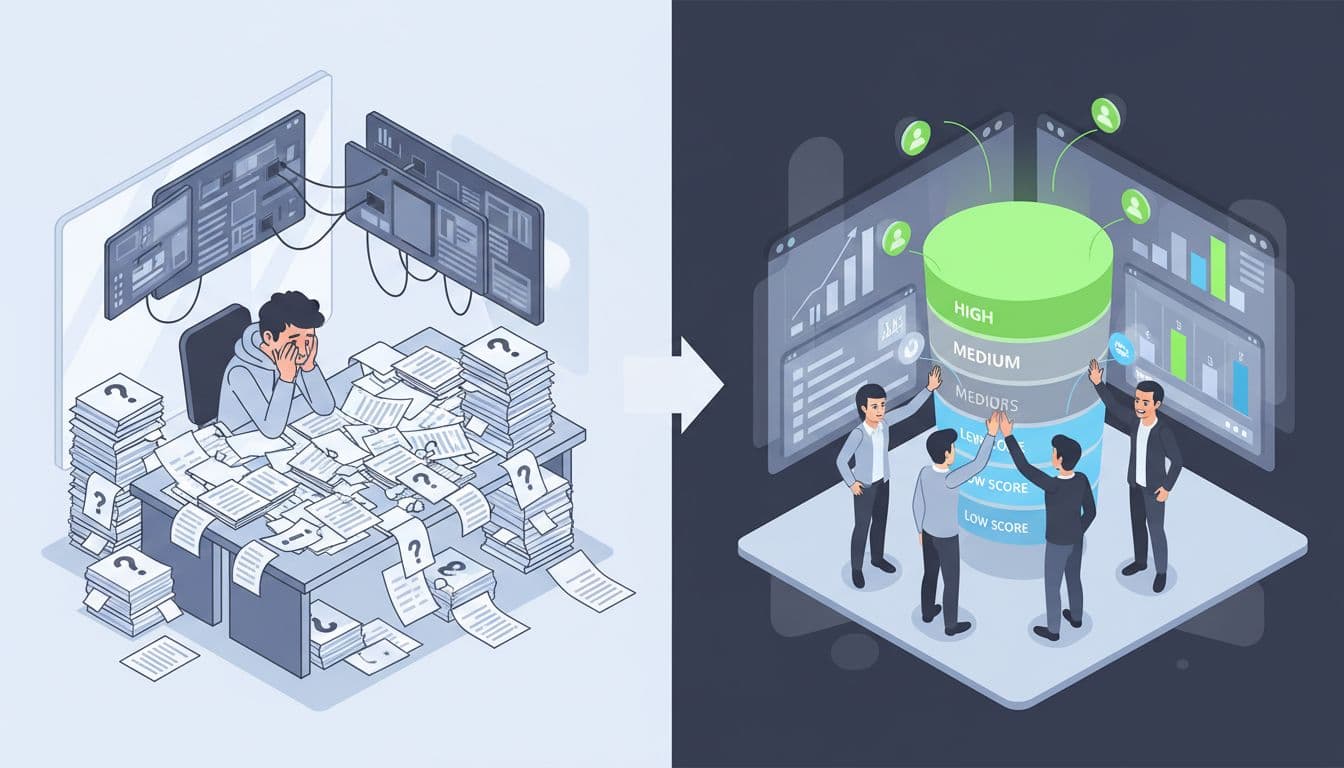
What is broken with your current lead scoring
Classic lead scoring in small SaaS teams is usually a mix of:
- Points for job title, company size, industry
- Points for page views, email opens, or “requested demo.”
- A random threshold someone picked six months ago
The result: “hot” leads that never buy, and quiet buyers that slip through. You end up with:
- Reps are chasing every ebook download
- ICP accounts with real intent are buried under low scores
- No shared trust in the score field
Scoring becomes noise instead of a decision tool.
Who actually feels the pain
In a 1–20 person B2B SaaS team, the pain shows up in three roles:
- Founders juggling product, fundraising, and a messy pipeline
- First sales hire or head of growth who must hit a number with limited data help
- Ops or RevOps generalist who owns the CRM and gets every “why is this lead MQL?” complaint
No one has time to babysit a scoring model. If it does not help them decide who to call today, they will ignore it.
Why does the problem get worse as you scale
When you start, you can eyeball every inbound and outbound reply. After a few months of growth:
- Lead volume doubles
- You add more channels
- You bring on 2–5 reps
Noise explodes. A good problem, but still a problem.
Without reliable scoring:
- Reps cherry-pick based on gut or geography
- Warm but non-obvious buyers (non-standard titles, smaller regions) get ignored
- CAC creeps up because you keep adding top-of-funnel, not accuracy
This is where predictive lead scoring can help if, and only if, you are ready.
Why common approaches to lead scoring fail
Manual processes
You triage leads by eye. You forward “good-looking” companies in Slack. You paste LinkedIn URLs into a channel.
It works for 20–30 leads a week. It collapses once you run real campaigns. Human judgment is good, but not scalable across every rep and channel.
Spreadsheets
The next step is usually a Google Sheet scoring model. Columns for job title, events, product usage, and a formula for score.
Spreadsheets are fine for a first pass, but:
- No one updates the rules
- The logic lives in one person’s head
- It rarely syncs cleanly with CRM and outbound tools
You get an interesting model that never gets used in daily workflows.
Over-engineering
On the other side, some teams try to jump straight to complex models: dozens of fields, behavioral events, and edge-case rules.
The more complex the model, the less your team understands why a score is high or low. If reps do not trust it, they will not prioritize it.
Premature tools
Many early-stage teams buy heavy “AI” platforms before they have:
- Clean CRM data
- A clear ICP
- Enough closed-won and closed-lost deals
Vendors can absolutely help, and there are strong products in this space, like the B2B SaaS-focused predictive lead scoring for B2B SaaS tools. But if your inputs are shaky, the output is still guesswork.
What actually works with predictive lead scoring

Process before software
Before you touch any tool, you need three things:
1. Defined ICP: Clear “good fit” criteria by firmographic data, user role, and core problem.
2. Reliable conversion data: At least a few dozen closed-won and closed-lost deals are tagged in the CRM.
3. One primary motion: Decide what you are scoring for: booked demo, trial activation, or paid conversion.
Predictive models only amplify patterns in your data. If the patterns are random, the “AI” just reflects that randomness.
Constraints and trade-offs
You will trade off between:
- Accuracy vs speed (complex models are slower to update)
- Interpretability vs power (simple rules are explainable, full ML models are not)
- Centralization vs flexibility (one global score vs variant by segment)
For a small team, aim for a simple blended model: a few clear rules plus a light predictive layer, not a black box.
Stage-appropriate guidance
A simple guide by stage:
| Stage | Team size | Lead volume/week | Best-fit approach |
|---|---|---|---|
| Pre-seed / Seed, founder-led | 1–5 | 10–50 | Manual triage + very light rules |
| Seed / early Series A | 5–15 | 50–300 | Rules-based scoring + basic predictive |
| Growing Series A | 10–20 | 300–1000+ | Full predictive model + segment variations |
Predictive lead scoring starts to make sense in the middle row, when rules alone cannot keep up. For more advanced tactics, the Worknet guide on lead scoring best practices for SaaS is a solid, deeper dive.
Solution categories for predictive lead scoring
Tool types, not brands first
Most options fall into three buckets:
1. Built-in CRM scoring: Native scoring in tools like HubSpot or Pipedrive, sometimes with basic predictive features.
2. Standalone predictive scoring platforms: Tools that plug into your CRM and product data, then output scores.
3. Custom models in BI or data tools: SQL, Python, or no-code models built on top of a warehouse, then pushed back to the CRM.
Buying criteria
For early-stage B2B SaaS, focus on:
- Speed to value in weeks, not quarters
- Native integration with your CRM and outbound stack
- Transparent scoring logic or at least clear explanation layers
- Ability to test against historical deals
The directive’s perspective on predictive lead scoring and revenue efficiency is helpful if you are also rethinking marketing spend.
Red flags to avoid
Walk away if a vendor:
- Needs six months of implementation for a 5-person team
- Cannot show performance on your historical data
- Hides all logic behind “proprietary AI” with no explanation
- Charges more than your total CRM bill in year one
If you feel you are buying an experiment instead of a workflow, hit pause.
Tool recommendations
You do not need a long vendor list here, but it helps to know where to look.
1. Built-in CRM predictive scoring: Best if you are already deep into a CRM’s ecosystem and want low friction. Overkill if you have fewer than 50 new leads a month.
2. Specialized predictive tools for B2B SaaS: Platforms like the ones in this roundup of lead scoring software tools for B2B SaaS are good fits once you have clear ICP data and at least a few dozen closed deals. Not ideal if your product, pricing, or ICP is still changing every quarter.
3. Custom models: Best when you have a data person in-house and real volume. Do not start here as a founder-led team without data support.
Assume some of these tools offer affiliate or partner deals. Treat that as a bonus, not a reason to choose them.
When to invest in predictive lead scoring
Predictive lead scoring is not a badge of maturity. It is a response to a clear problem: too many leads, not enough focus, and enough data to separate signal from noise.
You are ready to act when:
- Reps cannot touch every lead each week
- You have at least 50–100 closed-won and closed-lost deals in the CRM
- You know what a “good fit” account looks like and can write it down
You should wait when:
- You are still searching for product–market fit
- Lead volume is low enough for manual review
- Your data hygiene is poor, and basic fields are missing or wrong
Budget-wise, expect:
- $0–$100/month for simple rules in an existing CRM
- $200–$1,500/month for early-stage predictive tools
- Much more once you bring in data teams and warehouses
Start with rules and process, then add predictive when it clearly saves sales time or increases conversion.
In the end, effective predictive lead scoring is less about fancy models and more about disciplined thinking: clear ICP, clean data, and a score that your team actually uses to decide what to do every day. Get those right, then let the tools amplify what already works.


SaaSXtra.com is a SaaS product review and software marketing blog for business startups. For questions and inquiries on the blog, please send an email to the Editor at saasxtra[at]gmail[dot]com.