
Most founder-led SaaS teams treat internal linking as an afterthought. You ship features, push a few blog posts, and hope Google figures it out.
It never does.
Instead, high-intent pages stay buried, great posts get zero traction, and your blog turns into a content graveyard. This guide shows you how to turn internal linking into a simple, repeatable growth system that works even with a tiny team.
Internal linking as a silent growth blocker
On most early-stage SaaS sites, page links are random.
Writers add “related” links based on gut feel. Founders add a few CTAs in the footer. Product pages barely connect to the blog. Over time, you get:
- Orphan blog posts that have nothing linking to them
- Important pages are buried 5 to 6 clicks deep
- Top-of-funnel posts that never send traffic to sign-up or demo pages
For a small team, this hurts in three ways:
- Google struggles to crawl and understand your topics.
- Authority from your strongest pages does not reach new content.
- Users bounce because you never show them a clear next step.
If you are already investing in content or SEO, this is wasted budget.
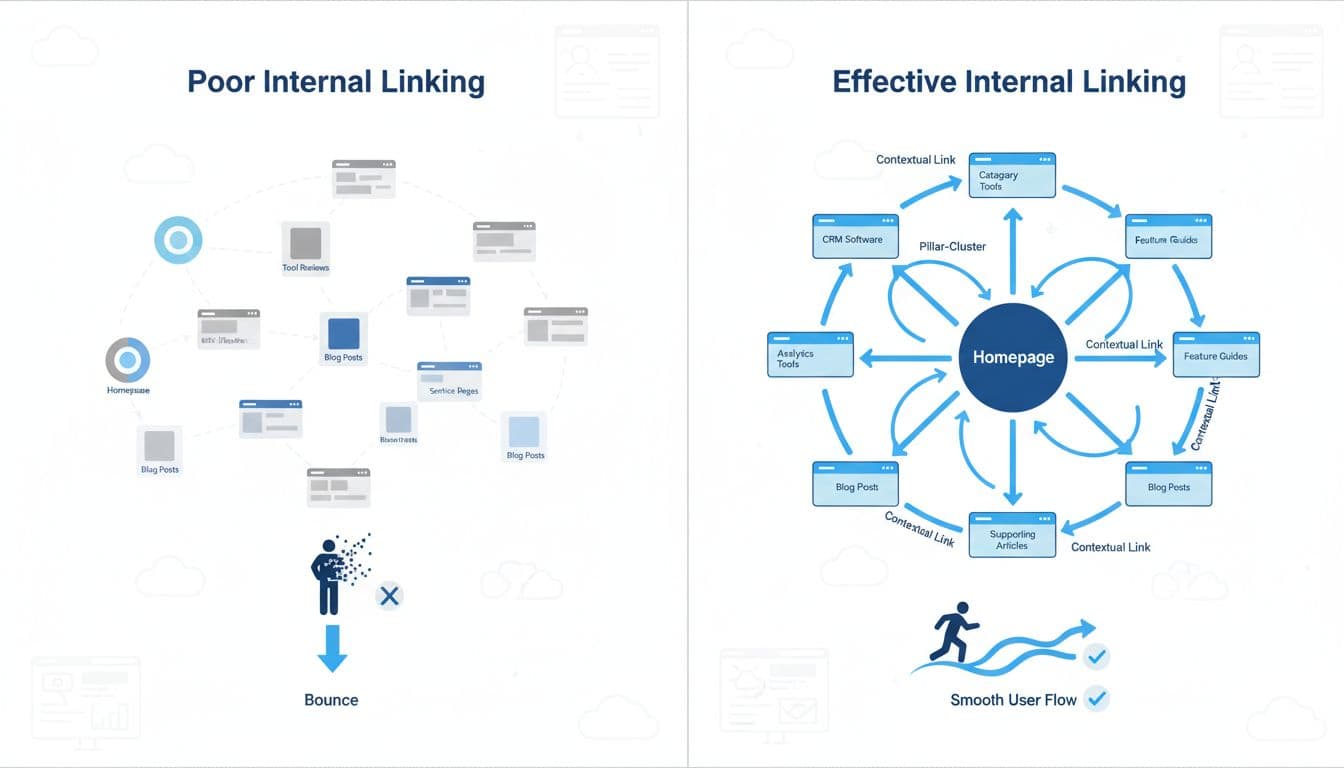
Comparison of a fragmented SaaS site with poor internal links versus a clean, connected structure that guides users and search engines.
What is broken, who feels it, and why it gets worse
The pain shows up differently by role:
- Founders see traffic growing slowly despite publishing more.
- Marketing leads juggle content calendars but cannot prove impact.
- RevOps / ops generalists see messy funnels with no content paths to the pipeline.
The core issue: no clear map of how pages should connect.
As you scale content from 10 posts to 50 or 200, the problem multiplies. New writers do not know which “pillar” to support. Old posts never get updated with links to fresh content. You end up with topic silos that do not talk to each other.
SEO practitioners are very clear in the current guidance: strong internal linking and topical clusters are a major ranking signal in 2025. Resources like these internal linking best practices for SaaS sites, such as the guide on internal linking best practices for SaaS, keep repeating the same theme: structure beats volume.
Why common internal linking approaches fail
1. Purely manual “add a few links” habits
Most teams tell writers: “Add 2 or 3 internal links per post.”
There is no list of priority pages, no cluster map, and no rules about anchor text. The result is:
- Links to random “nice to read” posts, not revenue pages
- Anchors like “here” or “this article” that tell Google nothing
- Duplicate links to the same 2 or 3 URLs in every post
You get effort without strategy.
2. Spreadsheets that nobody updates
Some teams try to fix this with a monster spreadsheet: every URL, target keyword, and number of links in and out.
It looks smart for one week. Then:
- New content never gets added
- Columns for anchor text and status go stale
- No one has time before publishing to check the sheet
The spreadsheet becomes another abandoned asset instead of an actual operating tool.
3. Over-engineered content graphs
At the other extreme, someone builds a complex “knowledge graph” or mind map of every topic.
For a 5-person SaaS team, this is overkill. You spend hours debating categories while writers wait for direction. The system is too complex to use day to day, so people revert to instinct.
4. Premature internal-linking tools
Many WordPress plugins and SEO tools now auto-suggest internal links. Some even promise to insert links automatically.
For an early-stage team, this backfires when:
- Tools suggest links based only on keywords, not intent
- Auto-inserted links create spammy patterns
- Everything points to blog posts instead of sign-up, demo, or pricing pages
Tools are useful, but not without a simple, human framework behind them. As the article on SaaS SEO internal linking points out, automation should follow strategy, not replace it.
If you also struggle with site structure or thin content, it is worth reviewing the common issues in this guide on SaaS SEO mistakes you must fix. Internal linking is often one of them.
A simple internal linking framework
You do not need a huge SEO team. You need a light process that your current writers and marketers can follow on every publish.
Think in three layers.
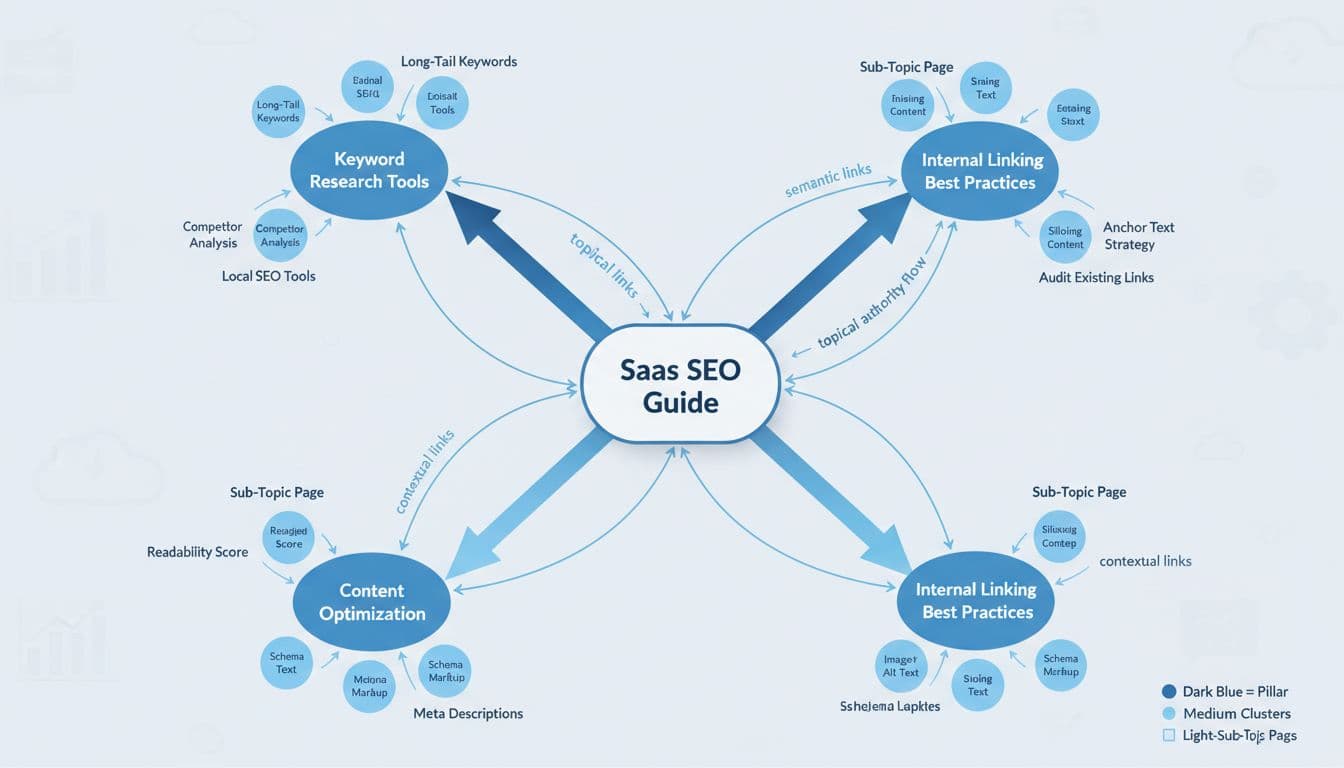
1. Define your pillars and clusters
Start with 3 to 5 pillar topics that drive revenue. For a B2B SaaS, that might be:
- “SaaS SEO”
- “Sales pipeline automation”
- “Customer onboarding”
Each pillar gets:
- 1 in-depth guide as the pillar page
- 6 to 20 cluster articles that go deep on subtopics
A good example of a pillar-style asset is this guide to inbound marketing for SaaS. Smaller posts can support and feed traffic into it.
2. Use a clear linking pattern
For each new or updated article:
- Link up to its main pillar using a descriptive anchor
- Link across to 1 or 2 related cluster posts in the same topic
- Link down to at least one product, pricing, or demo page
Also, make sure pillar pages link out to all key clusters. This hub-and-spoke pattern sends a strong topical signal to Google and gives users a clear content path.
Updated resources like these internal linking best practices reinforce the same pattern: relevant anchors, tight clusters, shallow click depth.
3. Guardrails and trade-offs for small teams
With limited time, you cannot optimize every URL. Focus on:
- All product, pricing, and “book a demo” pages
- Pillar guides for your top 3 to 5 topics
- Posts that already bring organic traffic
Then add rules the whole team can follow:
- Use keyword-rich anchors, but keep them natural and varied
- Aim for 3 to 7 internal links per 1,500-word article
- Avoid linking to very weak, off-topic, or thin pages
You can add depth later with technical work, such as discussed in this broader technical SEO guide for SaaS sites, but the simple framework above is enough to move the needle.
Stage-appropriate internal linking playbook
Your focus changes as the company grows, even if the framework stays the same.
Pre-seed to early traction
- Likely 10 to 20 URLs total.
- Build one strong pillar plus 3 to 5 support posts.
- Make sure every blog post links to one sign-up, free trial, or waitlist page.
Do not buy tools just for internal linking at this stage. A simple checklist and your CMS are enough.
Seed to Series A
Now you might have 40 to 150 URLs.
- Formalize your 3 to 5 pillars and cluster maps.
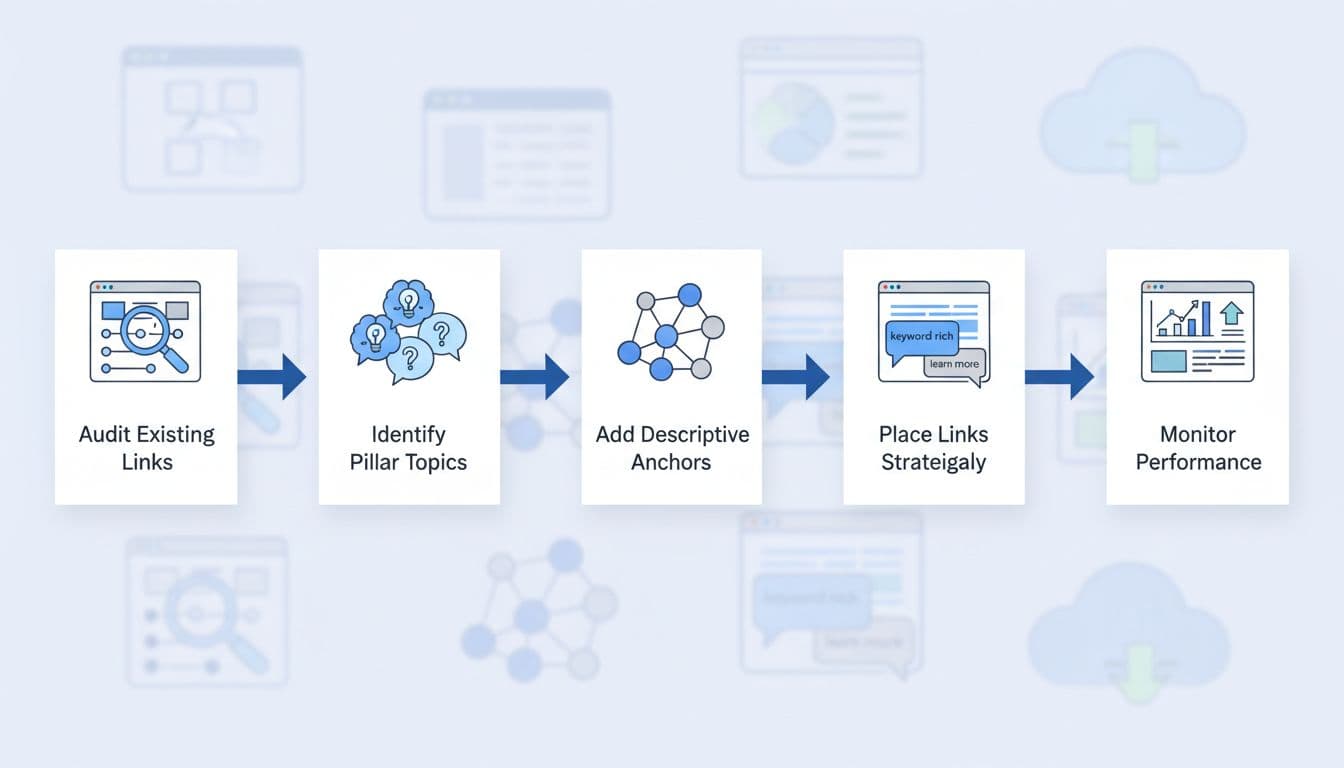
- Run a quick audit to find orphan pages and fix them.
- Add internal linking rules to your content brief template.
If you target users in multiple countries, make sure internal linking supports your global structure too. The playbook in this international SEO guide to reach worldwide audience pairs well with a strong internal link strategy.
Tool categories, buying criteria, and red flags
You do not need to start with tools, but once your site passes 80 to 100 URLs, they save time.
Useful tool types
- Crawlers to map links (for example, desktop crawlers or cloud crawlers).
- SEO suites that show internal links, anchor text, and orphan pages.
- CMS plugins that suggest internal links while you write.
- Analytics platforms to track how internal links change behavior.
When you are ready to deepen your link strategy, resources on internal and external links best practices can help you refine the mix.
Buying criteria
Look for tools that:
- Show links per URL, not only domain-level stats
- Surface orphan pages and click depth
- Let you filter by template, author, or content type
- Do not auto-insert links without review
Red flags:
- Promises to “fix all your internal links in one click.”
- No control over anchor text
- No way to exclude weak or off-topic pages
If the tool saves less than 2 to 3 hours per month for your team, skip it for now.
When to act, when to wait
You should prioritize internal linking if:
- You have 20-plus pages and are publishing monthly
- Some posts get traffic but do not send users to product pages
- New content takes months to index and rank
You can wait if:
- You have fewer than 10 URLs total
- Your positioning and ICP are still changing every few weeks
For the budget, plan on:
- 4 to 8 hours to set up your first pillar-cluster map
- 1 to 2 hours per month to keep links updated
- Optional spend on tools once the content volume justifies it
If you want a broader strategy that ties this into content production, pair this with your inbound plan, such as the one in this inbound content marketing strategies explained.
Conclusion: Make internal linking part of how you publish
Internal linking is not a one-off SEO project. It is a publishing habit.
Set a simple framework, teach your writers, and review links whenever you update content. For a small B2B SaaS team, this is one of the rare SEO moves that costs almost nothing and compounds over time.
If your next blog post does not clearly support a pillar and link users closer to sign up or sales, change it before you hit publish. Your future self and your traffic will thank you.

SaaSXtra.com is a SaaS product review and software marketing blog for business startups. For questions and inquiries on the blog, please send an email to the Editor at saasxtra[at]gmail[dot]com.